
2026-10-10
Why Vacuum Brazing is Superior to CAB for High-Pressure Aluminum Heat Exchangers
Compare vacuum brazing and CAB for high-pressure aluminum heat exchangers, including flux residue, magnesium-containing alloys, porosity control and pressure qualification.
Quick Answer: Vacuum brazing is often superior to controlled atmosphere brazing (CAB) for high-pressure aluminum heat exchangers because it is fluxless, avoids flux residue in fine passages and gives the process engineer tighter control over oxidation and joint cleanliness. It can also be suitable for magnesium-containing alloys that are difficult for standard CAB. However, no brazing process alone guarantees a pressure rating: the final capability depends on alloy, filler metal, joint design, furnace profile, inspection and pressure testing.
Vacuum brazing vs CAB is not a simple choice between a good process and a bad process. Both are established aluminum joining methods. CAB is widely used for high-volume production because it can be efficient and cost-effective with compatible alloys and controlled flux. Vacuum brazing is often selected when cleanliness, difficult alloy combinations, low residual contamination and high-integrity joints are more important than throughput.
For high-pressure aluminum heat exchangers, the decision should be based on the complete manufacturing route: the alloy system, filler metal, channel geometry, braze cycle and qualification tests. This guide explains where vacuum brazing offers real advantages, where CAB remains a practical choice, and which engineering claims should be verified before a pressure rating is accepted.
Vacuum Brazing vs CAB: What Is the Difference?
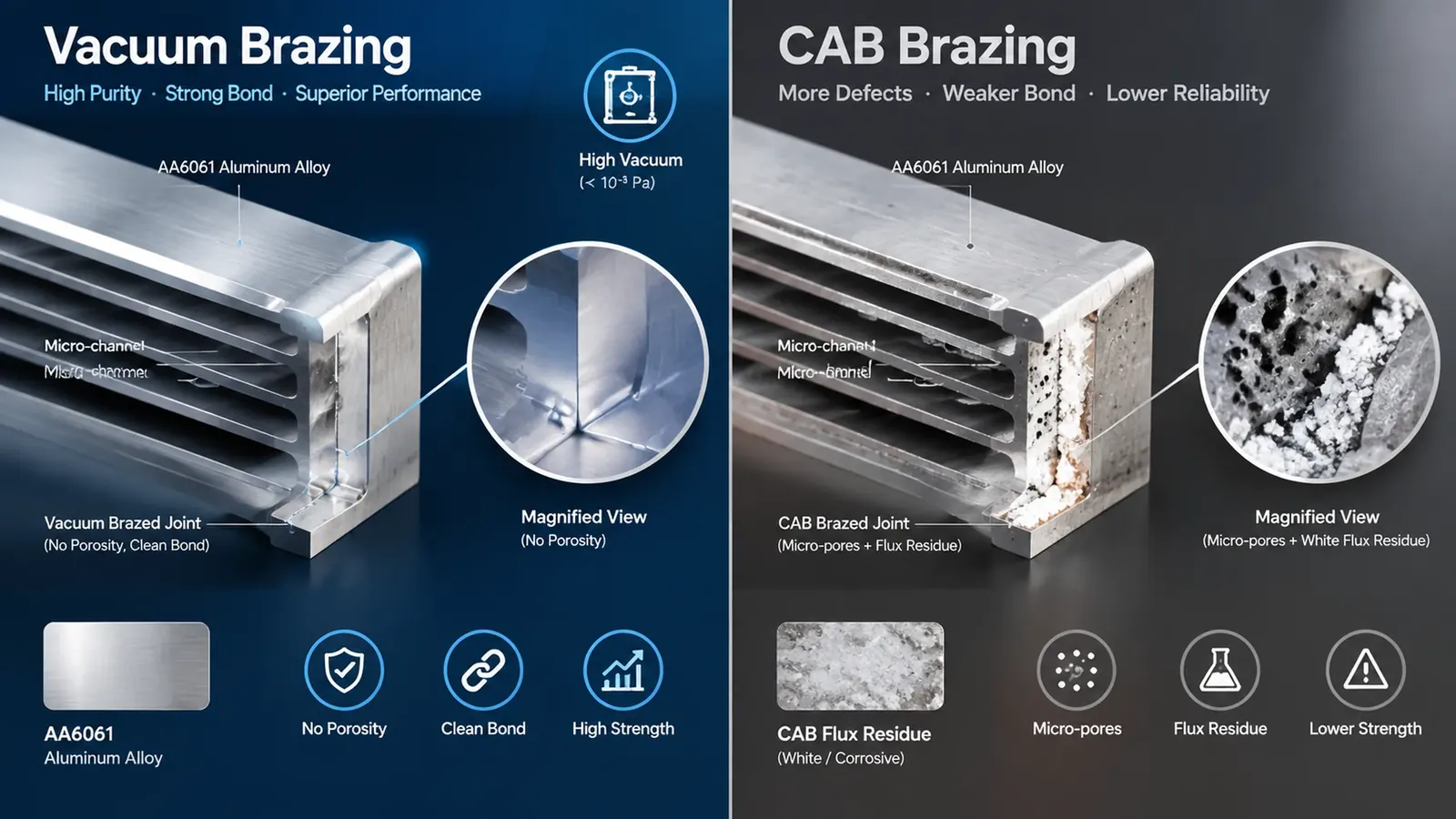
In vacuum brazing, the assembled aluminum core is heated in a vacuum furnace without a brazing flux. The vacuum reduces oxygen and water vapor around the joint. Filler metal, usually an aluminum-silicon alloy, melts and flows into the joint by capillary action. Depending on the alloy and furnace, the vacuum level may be in the high-vacuum range, but the exact cycle is process-specific.
In CAB brazing, the assembly is heated in a controlled nitrogen atmosphere with a fluoride-based flux. The flux removes the oxide layer and promotes filler flow. CAB is common in high-volume aluminum heat exchanger production, but flux application, drying, atmosphere control and residue management are critical process variables.
The difference matters inside a plate-fin or bar-and-plate core because the internal passages are narrow. Any residual flux, oxide or loose particle can affect flow, corrosion resistance or long-term cleanliness. Vacuum brazing removes the flux variable, but it does not remove the need for correct surface preparation, filler placement and furnace control.
Why Vacuum Brazing Is Often Preferred for High-Pressure Aluminum Heat Exchangers
1. Flux-Free Internal Channels
Vacuum brazing does not require a fluoride flux. For a high-pressure aluminum heat exchanger, this is important because the internal oil, coolant or gas passages cannot always be inspected or cleaned after brazing.
A flux-free process reduces the risk of:
- Residual flux blocking or narrowing micro-channels
- Flux-related contamination in oil or coolant circuits
- Galvanic or corrosion concerns associated with residue
- Additional cleaning and verification steps after brazing
CAB can be used successfully with proper flux control and post-braze cleanliness, but the vacuum route removes one source of internal contamination.
2. Better Options for Magnesium-Containing Alloys
Magnesium is added to some aluminum alloys to improve strength. It can also make flux-based brazing more difficult because it reacts with the flux and atmosphere. Vacuum brazing is often considered when the design needs a magnesium-containing alloy or a combination that is difficult to process with standard CAB.
Alloys such as AA6061 are heat-treatable and can provide higher strength than common 3003 brazing sheet, but they are not automatically “easy” to braze. AA6061 has a narrower process window, and the filler metal, surface condition and furnace profile must be qualified for the actual component. A braze trial, cross-section and mechanical test are more reliable than a generic alloy claim.
3. Tight Control of Oxidation and Joint Cleanliness
A controlled vacuum environment reduces oxidation during the high-temperature cycle. When the furnace profile, leak rate, dew point and loading pattern are controlled, the result can be clean filler flow and low-porosity joints.
However, low porosity is not the same as zero porosity. Porosity can still come from:
- Contaminated or oxidized surfaces
- Incorrect filler placement or quantity
- An unsuitable furnace profile
- Trapped air or volatiles
- Poor fixture support or uneven heating
- Alloy and filler incompatibility
For high-pressure service, the correct approach is to establish a qualified braze procedure and verify it through sectioning, leak testing and pressure testing.
4. Process Control for Fatigue and Pressure Cycling
High-pressure heat exchangers often see pressure pulses, thermal cycling and vibration rather than a single static pressure. A sound braze joint must resist crack initiation and growth under those repeated loads.
Vacuum brazing can support high-integrity joints, but fatigue performance is not controlled by the furnace alone. It also depends on:
- Joint fillet geometry and filler distribution
- Core and header design
- Material thickness and alloy strength
- Brazed-joint porosity and internal defects
- Thermal expansion differences
- Pressure-cycle amplitude and frequency
- Proof, burst and cyclic test results
For this reason, process selection should be linked to a qualification plan, not to a claimed pressure number.
Vacuum Brazing vs CAB Comparison
| Parameter | Vacuum Brazing | CAB Brazing | Engineering Consideration |
|---|---|---|---|
| Flux | Fluxless | Fluoride-based flux | Vacuum removes flux residue from internal passages; CAB requires flux control and cleanliness verification |
| Atmosphere | Vacuum furnace | Controlled nitrogen atmosphere | Vacuum reduces oxidation; CAB requires tight atmosphere and dew-point control |
| Alloy compatibility | Often selected for difficult or magnesium-containing alloys | Common with standard brazing sheet and compatible alloys | The exact alloy, filler and braze cycle must be qualified |
| Porosity control | Can achieve low porosity with qualified cycle | Can achieve low porosity with qualified flux and atmosphere | Neither process guarantees zero porosity |
| Production model | Often batch or lower-throughput | Often high-volume continuous production | CAB may be more economical for compatible, high-volume parts |
| Pressure capability | Design- and process-dependent | Design- and process-dependent | Pressure rating must be proven by design calculations and testing |
| Internal cleanliness | No flux residue | Requires flux residue management | Important for micro-channel and high-purity circuits |
| Typical selection driver | High integrity, cleanliness, difficult alloy | Cost, throughput, established aluminum brazing | Select by application, not by a generic superiority claim |
What Determines the Pressure Rating of a Brazed Heat Exchanger?
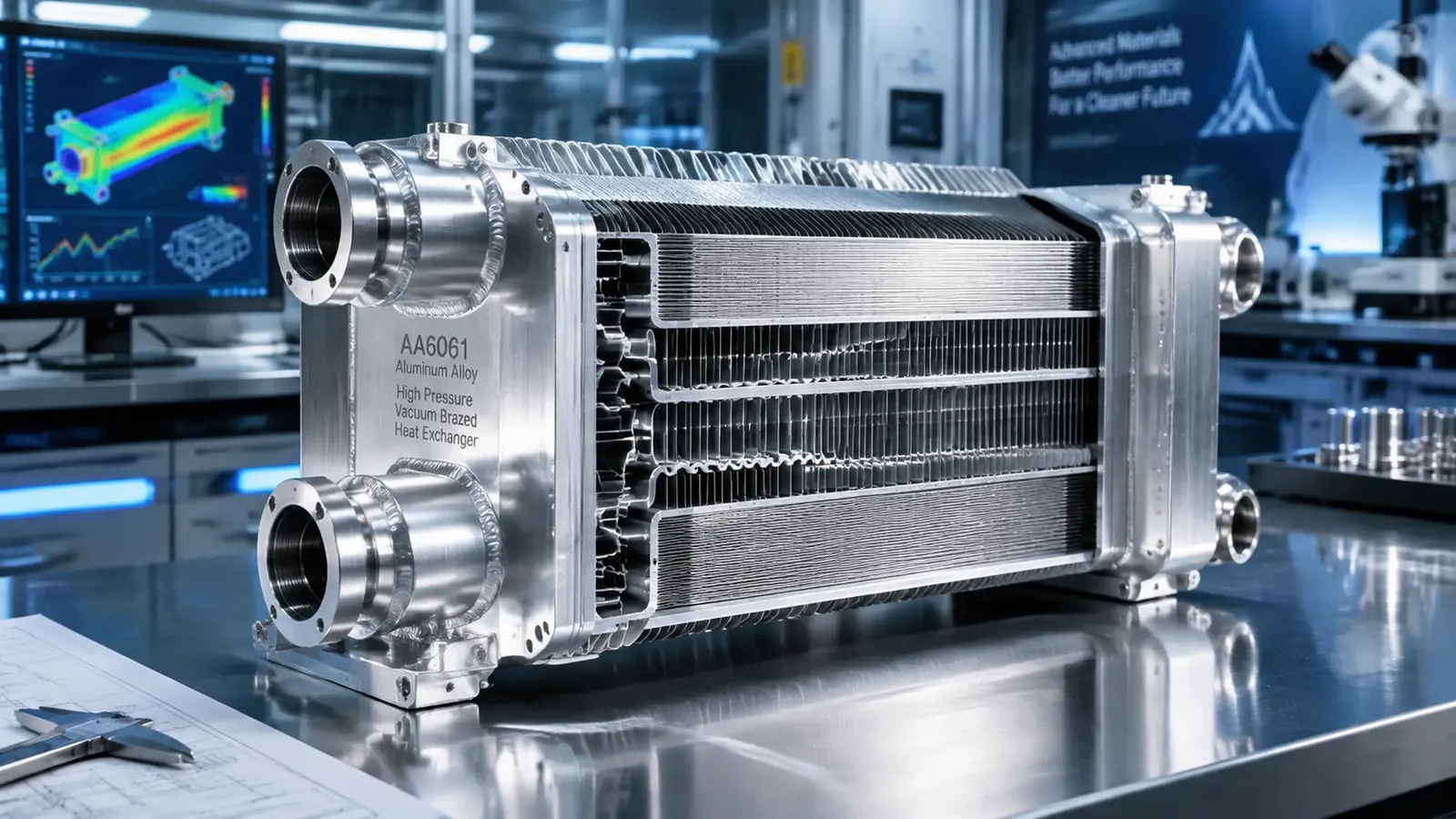
A brazing process does not create a pressure rating by itself. The rating comes from the complete design and qualification package:
- Alloy and temper: Base-metal strength, filler compatibility and post-braze properties.
- Core and header design: Wall thickness, channel geometry, fillet size and stress concentration.
- Braze quality: Filler coverage, porosity, voids, unmelted filler and joint discontinuities.
- Pressure and temperature: Working pressure, test pressure, operating temperature and thermal gradients.
- Cyclic duty: Pressure pulses, vibration and thermal cycling.
- Testing: Helium leak, proof pressure, burst, pressure-cycle and sectioning results.
- Traceability: Material certificates, process records and test reports.
A vacuum-brazed component can be unsuitable for high pressure if the design or process control is poor. A CAB-brazed component can be suitable for pressure service when the design and flux process are properly qualified. The correct question is not “which process sounds stronger,” but “which qualified process meets the pressure, cleanliness and production requirements?”
AA6061 and Magnesium-Containing Alloys: What to Verify
AA6061 is often specified for structural aluminum parts because it can be heat-treated to higher strength than common 3003 alloys. It can also contain magnesium, which affects oxide formation and brazing behavior.
Before using AA6061 in a brazed pressure component, confirm:
- The filler metal is compatible with the base alloy.
- The braze temperature stays within a safe process window.
- The furnace atmosphere or vacuum can handle the magnesium level.
- The post-braze heat treatment will not damage the joint.
- Cross-sections show adequate filler flow and acceptable porosity.
- Pressure and leak tests meet the application requirement.
In many heat exchanger designs, the fluid core uses a brazing-sheet alloy such as 3003 with a 4045 or similar clad filler, while higher-strength alloys are used for selected structural components. The final material combination should be reviewed as a system, not selected from a single alloy name.
When CAB Is the Better Choice
CAB remains a strong option when:
- The alloy system is well matched to controlled atmosphere brazing.
- Production volume is high and furnace throughput matters.
- The design can tolerate the required flux process and cleaning route.
- The pressure and cleanliness requirements are met through qualified testing.
- The supplier has mature CAB process control and traceability.
The decision should be made with the heat exchanger manufacturer, not from a generic process comparison. Ask for the proposed alloy, filler, braze cycle, inspection plan and pressure-test basis.
Typical High-Pressure Applications
A vacuum-brazed construction is often selected when a bar and plate cooler, hydraulic oil cooler, air compressor cooler or industrial radiator assembly must combine clean internal passages with pressure-cycle reliability. Typical applications include:
- Bar and plate cooler assemblies for high-pressure oil circuits and compact hydraulic systems
- Hydraulic oil cooler with fan for mobile machinery and industrial power units
- Air compressor cooler and aftercooler sections where flux residue and internal cleanliness matter
- Industrial radiator and plate-fin heat exchanger assemblies for heavy duty, high-vibration equipment
The common requirement is not the end market; it is a qualified braze process, a pressure-rated design and a test plan that matches the actual duty.
How to Qualify a High-Pressure Brazed Heat Exchanger
A practical qualification plan should include:
- Design review: pressure, temperature, flow, vibration and installation loads
- Material and filler review: alloy, temper, clad layer and compatibility
- Braze procedure qualification: furnace profile, vacuum or atmosphere, fixturing and loading
- Destructive sectioning: filler flow, fillet size, voids and porosity
- Non-destructive inspection: visual, dimensional and helium leak testing
- Pressure testing: proof, burst and cyclic pressure tests as required
- Performance testing: pressure drop and thermal performance at the design point
- Documentation: material certificates, process records and test reports
For custom design, OEM ODM production or factory wholesale requirements, our engineers can review the custom manufacturing process, the bar and plate oil cooler assembly, the custom OEM oil cooler and the factory wholesale plate-fin heat exchanger program.
FAQ
Why is vacuum brazing superior to CAB for high-pressure aluminum heat exchangers?
Vacuum brazing is often preferred for high-pressure, high-integrity aluminum heat exchangers because it is fluxless, minimizes corrosive flux residue and supports tightly controlled joint cleanliness. It can also be suitable for certain magnesium-containing alloys. Final pressure capability still depends on alloy selection, core design, filler metal, braze cycle and pressure testing.
Does vacuum brazing guarantee zero porosity?
No process guarantees zero porosity. A controlled vacuum braze can reduce oxidation and gas entrapment and can produce low-porosity joints, but porosity depends on surface preparation, filler placement, furnace profile, alloy combination and fixture design. Cross-section inspection and leak testing remain necessary.
Can CAB brazing handle pressures above 20 bar?
Pressure capability is not determined by the process name alone. CAB is widely used for aluminum brazing and can be used in pressure-rated components when the alloy, joint design, flux control and testing are suitable. A specific design must be qualified against its working pressure, pressure cycles and safety factor.
Why is AA6061 sometimes difficult to braze?
AA6061 is a heat-treatable, magnesium-containing aluminum alloy. Magnesium can affect flux behavior and vacuum processing, and the alloy has a narrower braze window than common 3003/4045 brazing sheet. A qualified filler, surface preparation and furnace profile are required, and the exact component should be validated by trial and sectioning.
What tests should a high-pressure brazed heat exchanger pass?
Depending on the application, qualification can include visual and dimensional inspection, cross-section metallography, helium leak testing, proof pressure testing, burst testing, pressure-cycle testing and pressure-drop verification. The test plan should reflect the specified working pressure, temperature range and fatigue duty.
Need Help Selecting a Brazing Process and Pressure Rating?
Send us the alloy, fluid, working pressure, pressure-cycle requirement, temperature range and available envelope. Our engineers will review the brazing route, joint design and test plan before confirming a production-ready heat exchanger.
Request a Vacuum Brazing Review and Quotation
Need Help Selecting an Oil Cooler?
Send us your specs or drawings and our engineers will size the right cooler for you within 24 hours.
Get a Free Quote Chat on WhatsApp