
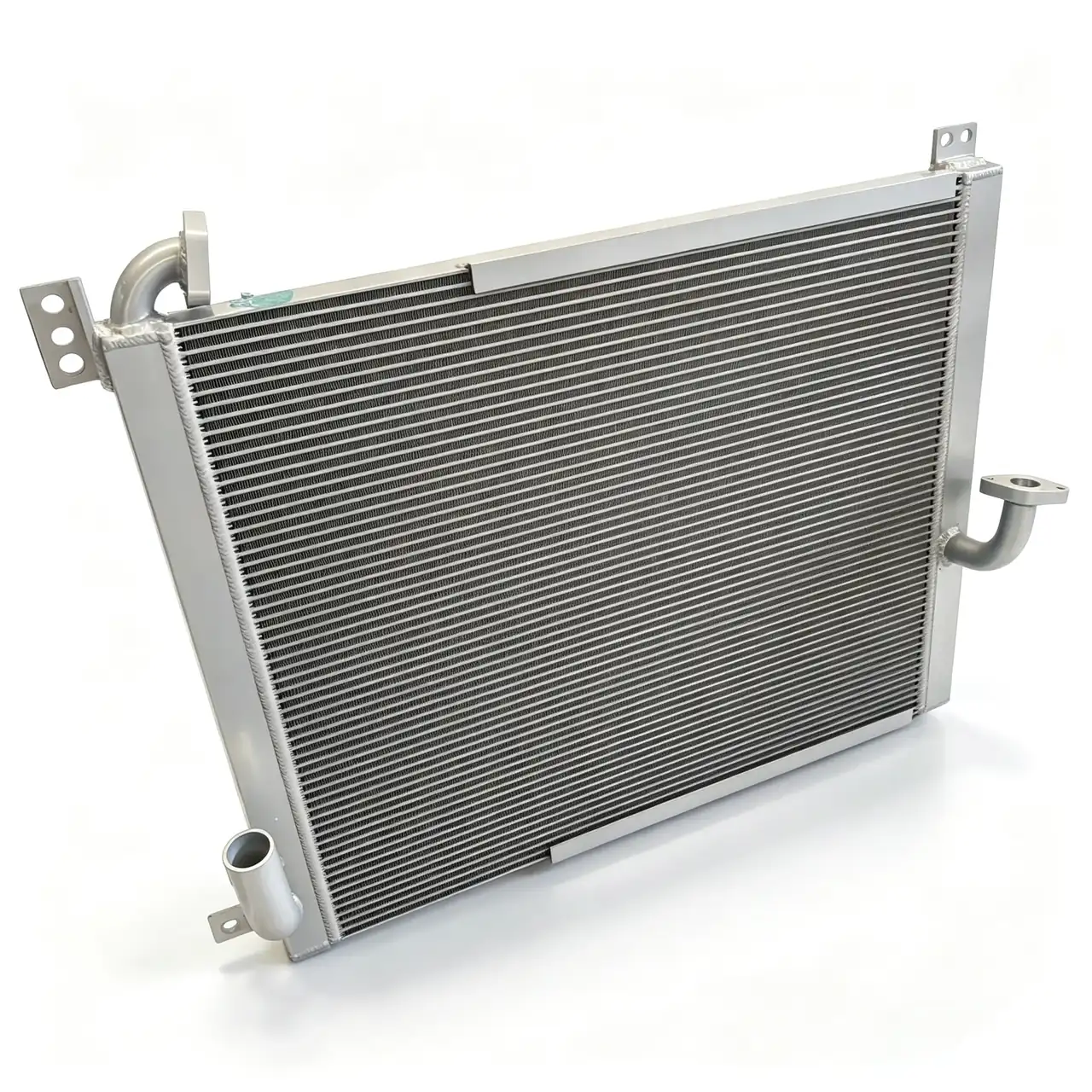
Komatsu Hydraulic Oil Cooler Replacement Starts With Fitment
A Komatsu excavator hydraulic oil cooler replacement should not be ordered from the machine brand alone. Two excavators that look similar can use different oil coolers because of the dash model, production period, engine and hydraulic package, mounting frame, fan arrangement or hose routing.
This page explains the information our engineers use to review an aftermarket Komatsu hydraulic oil cooler, the dimensions that matter most, and what to prepare before requesting a quotation. The aim is to avoid a cooler that looks close but does not fit or perform correctly in service.
Why "Komatsu Excavator" Is Not Enough to Confirm Fitment
Komatsu has produced many PC-series machines, and the same broad family can have several cooler variants. A PC200, PC300 or PC360 label is only a starting point. It does not confirm:
- the exact core thickness or fin density;
- the tank shape and inlet/outlet orientation;
- the mounting-hole pattern and bracket position;
- the required oil flow and allowable pressure drop;
- the coating or corrosion protection needed for the working environment;
- whether the original cooler has already been replaced with a different design.
For a reliable replacement, confirm the machine identity and the cooler interfaces. If the original part number is not readable, use measurements and photos to rebuild the fitment record.
Fitment Details to Confirm Before Ordering
| Information to confirm | Why it matters | What you can send |
|---|---|---|
| Machine model and serial number | Identifies the correct machine build and possible production changes | Nameplate photo and full model designation |
| Old Komatsu part number | Provides a direct reference when the number is readable | Photo of the label, casting mark or stamped plate |
| Core and tank dimensions | Controls available space, cooling area and hose clearance | Length, width and thickness measured at fixed points |
| Inlet and outlet position | Determines hose routing, connection angle and installation labour | Photos with a ruler and the connection thread or flange size |
| Mounting-hole pattern | Prevents frame modification and vibration problems | Centre-to-centre distances, hole diameter and bracket orientation |
| Oil flow and working temperature | Supports the correct internal-flow and cooling selection | System flow in L/min, normal and alarm oil temperatures |
| Working environment | Defines coating, contamination and maintenance requirements | Coastal, mining, quarry, desert or general construction duty |
Common Komatsu Families We Can Review
| Machine family | Typical search intent | Important fitment note |
|---|---|---|
| PC200 series | PC200 hydraulic oil cooler replacement | Dash model, production year and mounting arrangement must be confirmed |
| PC300 series | PC300 excavator oil cooler replacement | Core dimensions and port locations can differ between builds |
| PC360 series | PC360 hydraulic cooler replacement | Confirm the complete interface, not only engine displacement |
| PC400 and larger | Heavy-duty excavator cooler replacement | Review flow, vibration, mounting load and service access |
| Other PC and wheeled models | Custom replacement cooler | Send the nameplate, measurements and old-part photos for review |
These families are shown to help organise the fitment review. They are not a statement that one cooler fits every machine in the family. The approved drawing controls the final design.
How Our Fitment Review Works
- Collect machine and cooler data. Send the model, serial number, old part number, photos and measurements that are available.
- Identify the critical interfaces. Our engineers compare core size, tank geometry, port positions, mounting points and available clearance.
- Prepare a quotation drawing. The proposed replacement is defined before production, including the items that must match the original installation.
- Confirm the drawing. You review the fitment-critical dimensions and approve the final specification.
- Manufacture and inspect. The cooler is produced to the approved drawing, protected for shipping and packed with the agreed order documentation.
For urgent replacement-part projects, mark which dimensions are fixed and which can be adjusted. This helps reduce back-and-forth when the original cooler is damaged or the label is missing.
Replacement Cooler Specifications to Agree
| Parameter | Typical selection range | Confirmed at quotation |
|---|---|---|
| Core construction | Aluminium vacuum-brazed or bar-and-plate | Selected to suit the machine and duty |
| Surface finish | Black anti-corrosion coating | Coating system and inspection requirement confirmed |
| Ambient working condition | Up to 50°C in demanding projects | Final rating reviewed against the application |
| Working pressure | Up to 2.5 MPa | Confirm system pressure and safety factor |
| Oil flow | 20-500 L/min | Matched to the hydraulic circuit and allowable pressure drop |
| Connections | G thread, SAE or custom | Position, angle, thread and flange fixed on the drawing |
| Mounting | Original-style or custom bracket | Hole pattern and vibration control confirmed |
| Packing | Protective caps and export packing | Packing method agreed for the order quantity |
The ranges above are selection guidance, not a universal specification for every Komatsu excavator. The final cooler should be reviewed against the machine data and the quotation drawing.
Black Anti-Corrosion Coating for Coastal and Mining Conditions
A hydraulic oil cooler can be exposed to humid air, salt-laden coastal atmosphere, abrasive dust, mud and repeated washdown. The external fins and tank surfaces are particularly vulnerable because they combine thin aluminium sections with a contaminated working environment.
A black anti-corrosion coating can help protect the external surfaces when it is specified correctly and applied before the cooler enters service. For project orders, state the environment and any required coating standard in the inquiry so the finish can be included in the quotation.
Coating is not a substitute for correct maintenance. The cooling package should still be inspected for dust packing, bent fins, leakage and blocked airflow during scheduled machine service.
Aftermarket vs OEM: What to Compare
| Decision point | What to review |
|---|---|
| Fitment basis | Original part number, approved drawing or measured interfaces |
| Cooling performance | Oil flow, heat load, ambient temperature and allowable pressure drop |
| Availability | Whether a replacement can be produced while the machine is down |
| Custom dimensions | Whether the frame, fan or hoses allow a rebuilt design |
| Documentation | Drawing approval and the inspection records agreed for the order |
| Total installed cost | Cooler price, freight, downtime, fitting labour and future serviceability |
The best choice is not simply the lowest quoted price. For a machine working in a remote mine or coastal project, fitment confidence, delivery time and service access can matter as much as the unit price.
How the Hydraulic Oil Cooler Works
- Hot hydraulic oil leaves the working circuit and enters the cooler.
- Oil passes through the internal channels of the aluminium core.
- Heat transfers from the oil to the core and fins.
- Airflow from the machine fan or a dedicated fan carries heat away.
- Cooled oil returns to the hydraulic system at a controlled working temperature.
If the machine continues to overheat after replacement, check oil flow, fan airflow, thermostat or bypass operation, contamination and the complete hydraulic circuit rather than assuming the cooler is undersized. See our guide to how an excavator hydraulic oil cooler works.
What to Send for a Faster Quote
Komatsu cooler inquiry checklist - Machine model and full serial number - Old Komatsu part number, if readable - Photos of the installed cooler and nameplate - Core length, width and thickness - Inlet and outlet position, size and type - Mounting-hole pattern and bracket photos - Hydraulic oil flow in L/min - Normal and alarm oil temperatures - Working environment and required coating
Clear measurements and photos usually save more time than a long description. If the machine is still working, measure the installed cooler before removal where it is safe to do so.
Applications and Replacement Projects
This replacement approach is suitable for Komatsu excavators used in construction, quarrying, mining, earthmoving and coastal projects. It can also be reviewed for other earthmoving machines when the old cooler can be identified or measured.
For related cooling work, review excavator coolers, plate-fin hydraulic oil coolers and CAT excavator replacement radiators.
Maintenance and Troubleshooting Links
- How an excavator hydraulic oil cooler works
- Why excavator radiators leak at header joints
- How to prevent mining radiator dust clogging
- Construction machinery oil cooler solutions
Custom and OEM Manufacturing
If the original cooler is discontinued, modified or no longer available, send us the machine data, old-part photos and any available drawing. Our engineers can review a custom vacuum-brazed or bar-and-plate replacement, prepare a quotation drawing and discuss prototype evaluation. See our custom manufacturing process or contact our team.
Facing overheating or a difficult Komatsu replacement? Send the machine model, serial number, photos and dimensions. Our engineers will confirm what information is needed and review the replacement within 24 hours where possible.