
2026-09-12
Why do excavator radiators leak at the header tank joints?
Repeated excavator radiator leaks usually start at the header-to-core joint. Learn the vibration, thermal shock and pressure causes, how to verify them, and when a fully welded aluminum replacement is the better fix.
Bottom line: Excavator radiator leaks at header tank joints are usually caused by vibration fatigue, thermal shock or pressure spikes. Sealing only the visible crack often allows the leak to return because the joint still sees the same stress. A durable repair corrects the cap and mounting system and uses a fully welded, reinforced aluminum radiator for severe mining and construction duty.
Why the Header Tank Joint Becomes the Leak Point
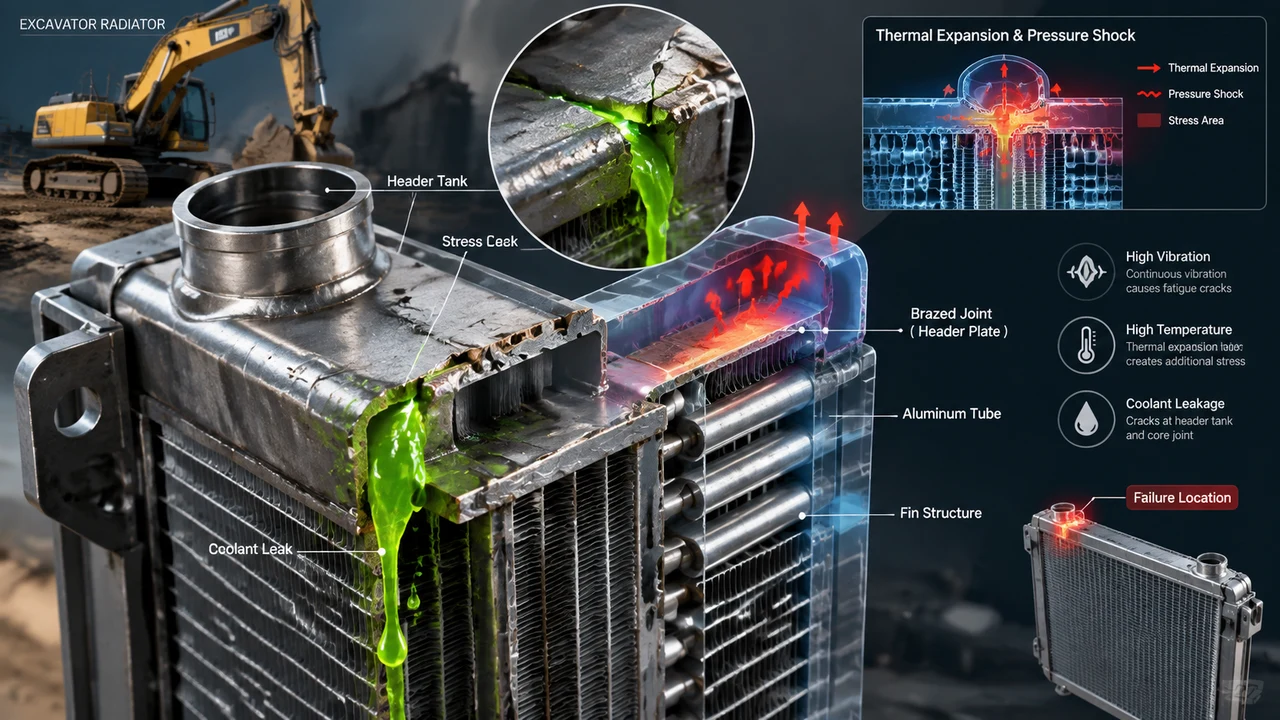
The header tank distributes coolant into the radiator core. Its connection to the core must resist constant vibration, repeated heat cycles and changing internal pressure while remaining sealed.
In a conventional crimped or brazed radiator, the tank-to-core joint depends on gaskets, folded tabs, or a thin braze layer. These designs can work well in light-duty vehicles, but an excavator adds high-frequency engine and hydraulic vibration, shock loads from the bucket and undercarriage, and rapid changes in load and coolant temperature. The joint becomes the weakest part of the assembly, so coolant staining or a visible crack often appears at the header rather than in the middle of the core.
Three Root Causes of Header Tank Joint Leaks
1. High-Frequency Vibration Fatigue
Mining and construction excavators operate with continuous vibration from the engine, hydraulic pumps, travel motors and attachment impacts. If the radiator is rigidly mounted or the vibration isolators have failed, that movement is transferred into the tank-to-core seam.
Repeated flexing can fatigue the braze, solder or surrounding aluminum. A hairline crack then grows until coolant seeps under pressure. Leaks that return after one repair commonly indicate that vibration is still reaching the joint.
2. Thermal Shock and Uneven Expansion
Excavator engine load changes quickly during digging, lifting and travel. Coolant temperature and internal pressure rise and fall with those changes. If a plastic tank, stamped metal header and aluminum core expand at different rates, the joint experiences repeated mechanical strain.
Cold starts followed by heavy work can make the effect more severe. The leak may appear only after the machine reaches operating temperature, when pressure and expansion are highest.
3. Pressure Spikes From a Faulty Radiator Cap
A radiator cap controls system pressure and allows coolant to move to the recovery bottle as it expands. If the cap does not relieve pressure correctly, or if the recovery system is blocked, pressure can exceed the joint's design limit.
A swollen hose, coolant pushed out after shutdown, or a leaking recovery bottle can point to a pressure-control problem. Replacing the radiator without correcting the cap or blockage can damage the replacement in the same way.
How to Confirm a Header Tank Joint Leak
Before ordering parts, confirm where the coolant is coming from and whether more than one fault is present.
- Clean and dry the radiator. Wash away old coolant, dust and oil, then run the machine to normal temperature. A dry surface makes the first seep easier to locate.
- Pressure-test the cooling system. Use the correct test pressure and inspect the header-to-core seam, tank walls, hose necks and cap area.
- Inspect the cap and recovery system. Verify the pressure rating, seal condition, relief operation and recovery hose. A cap that is stuck closed can create damaging pressure spikes.
- Check mounts and vibration isolators. Look for collapsed rubber, missing fasteners, cracked brackets, contact marks and restricted movement between the radiator and chassis.
- Check hoses, clamps and fan clearance. A hose pulling on the tank can add mechanical load, while fan contact or debris can cause damage that looks like a joint failure.
If the seam is cracked, distorted or leaking along the braze line, a surface seal is only a temporary measure. Permanent repair requires removing the stress from the joint or replacing the radiator with a stronger assembly.
Why Fully Welded Aluminum Radiators Resist These Failures
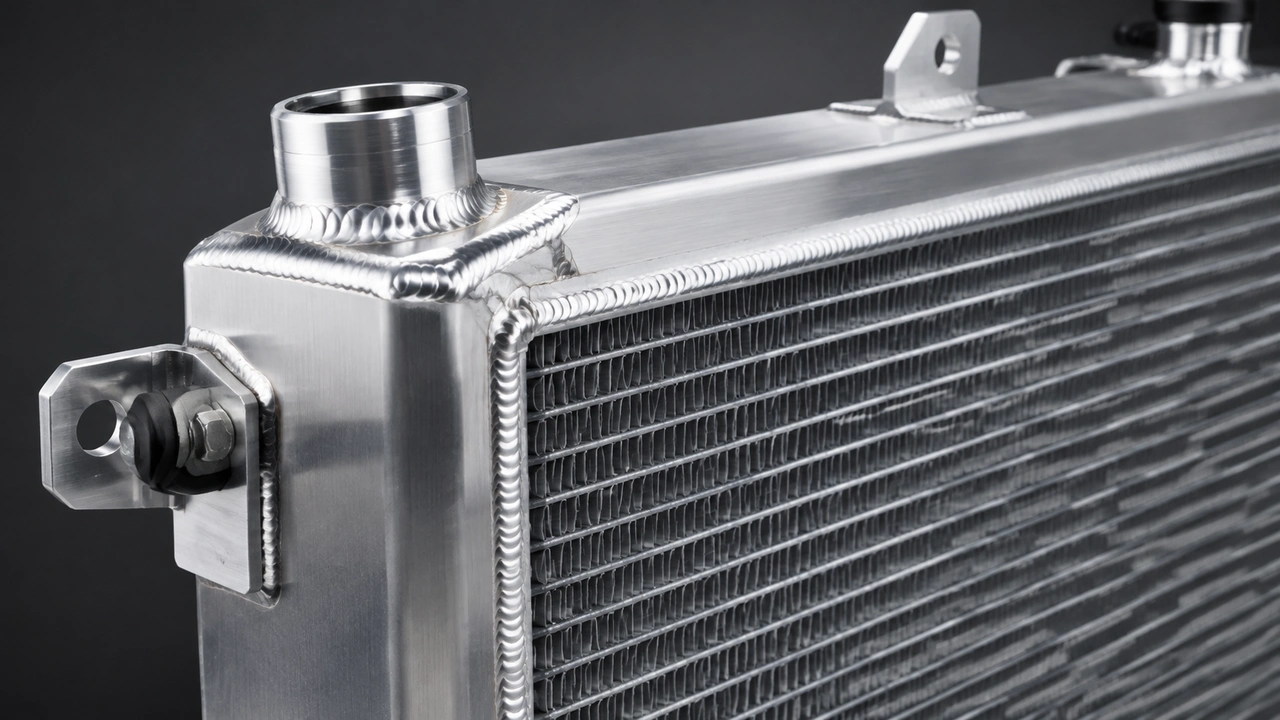
A heavy-duty fully welded radiator joins the tank and core with continuous metal structure instead of relying only on a crimped gasket or a narrow braze seam. Reinforced headers and structural side channels reduce flexing, while heavy-gauge aluminum tanks are better able to resist pressure changes and repeated thermal cycling.
This construction is not a substitute for correct installation. The replacement must still match the machine's cooling capacity, connection positions, mounting points and cap specification. It must also be isolated from chassis vibration in the same way the original radiator was designed to be.
| Failure factor | Standard crimped or plastic-tank radiator | Heavy-duty fully welded aluminum radiator |
|---|---|---|
| Header-to-core joint | Gasket, crimp or brazed seam can fatigue | Continuous welded metal joint with reinforced headers |
| Vibration resistance | More dependent on isolation and mounting condition | Stronger structure, but correct isolation is still required |
| Thermal cycling | Different tank and core materials can move at different rates | Uniform aluminum structure can expand more consistently |
| Pressure spikes | Joint may open if the cap does not relieve correctly | Reinforced tanks and seams provide greater resistance |
| Repair approach | Seam damage is difficult to repair reliably | Replace the affected assembly and correct the root cause |
| Best application | Light-duty or replacement use | Mining, quarry, construction and other severe-duty excavators |
Repair or Replace an Excavator Radiator?
A small external leak may be sealed temporarily to finish a shift, but a cracked header-to-core joint is a structural failure. Cleaning the area and applying sealant does not restore the strength of the seam, and the repair can fail without warning when the machine reaches full operating pressure.
Replacement is normally the more reliable choice when:
- The crack runs along the tank-to-core seam.
- The leak returns after a previous repair.
- The header or tank is distorted.
- The radiator has overheated or suffered severe vibration damage.
- The machine is used in mining, quarrying or another high-hour severe-duty application.
If the radiator is otherwise serviceable, compare the cost of a tested repair with the cost of repeat downtime. For a machine that depends on daily production, a reinforced replacement assembly is often the lower-risk option.
Choosing a Heavy-Duty Replacement Radiator
Use these checks before approving a replacement:
- Confirm fitment: Compare mounting points, overall envelope, hose positions and fan clearance with the machine.
- Match the cooling duty: Review coolant flow, heat load, ambient conditions and the fan or airflow arrangement.
- Inspect the joint design: Ask how the tank is attached to the core and whether the header has reinforcement at high-stress areas.
- Verify pressure control: Install the correct cap and confirm that the recovery system can relieve expanding coolant.
- Restore vibration isolation: Replace worn isolators and check that brackets, hoses and guards do not preload the radiator.
- Pressure-test before installation: A leak test should be completed before the machine returns to service.
For severe-duty applications, review our heavy-duty excavator cooler solutions or the CAT replacement radiator assembly. Send the machine model, photos and connection dimensions so the replacement can be checked against the original installation rather than selected by size alone.
Prevent the Next Header Joint Leak
The radiator is only one part of the cooling system. A lasting repair requires the cap to relieve pressure correctly, the mounts to control movement, the hoses to avoid pulling on the tank, and the coolant to remain clean and correctly mixed.
When a header tank joint fails repeatedly, treat it as a system problem. Identify the vibration, thermal or pressure source, replace damaged isolation components, and use a radiator designed for the machine's real duty cycle.
Frequently Asked Questions
Can an excavator radiator header tank leak be repaired?
A temporary external seal may slow a small seep, but a cracked or fatigued header-to-core joint will usually reopen under vibration and thermal cycling. The durable repair is to replace the affected radiator assembly or use a reinforced welded replacement.
Why does a new excavator radiator leak at the same joint?
If the pressure cap, mounts, hoses or vibration isolation are not corrected, the new radiator can see the same pressure spikes and movement that damaged the original. Inspect the complete cooling installation, not only the failed seam.
Does a fully welded aluminum radiator guarantee no leaks?
No design can guarantee zero leaks. A fully welded tank-to-core structure removes rubber gaskets and weak braze seams, but correct installation, pressure cap rating, coolant condition and vibration control are still required.
What information is needed before ordering a replacement?
Provide the machine make and model, mounting points, inlet and outlet positions, pressure cap rating, fan clearance, coolant flow and the operating heat load. Photos and dimensions help confirm the replacement envelope.
Can TH build a custom replacement for CAT, Komatsu, Hitachi or Kobelco excavators?
Yes. Send the machine model, photos, dimensions and connection details. TH can review a custom or replacement heavy-duty aluminum radiator design for the application.
Need Help Selecting an Oil Cooler?
Send us your specs or drawings and our engineers will size the right cooler for you within 24 hours.
Get a Free Quote Chat on WhatsApp