
2026-10-19
How to replace an OEM copper-brass radiator with a heavy-duty aluminium radiator on a CAT excavator?
Replacing a CAT excavator copper-brass radiator with a heavy-duty aluminium unit is a fitment, airflow, vibration, coolant and pressure-job, not a simple material swap.
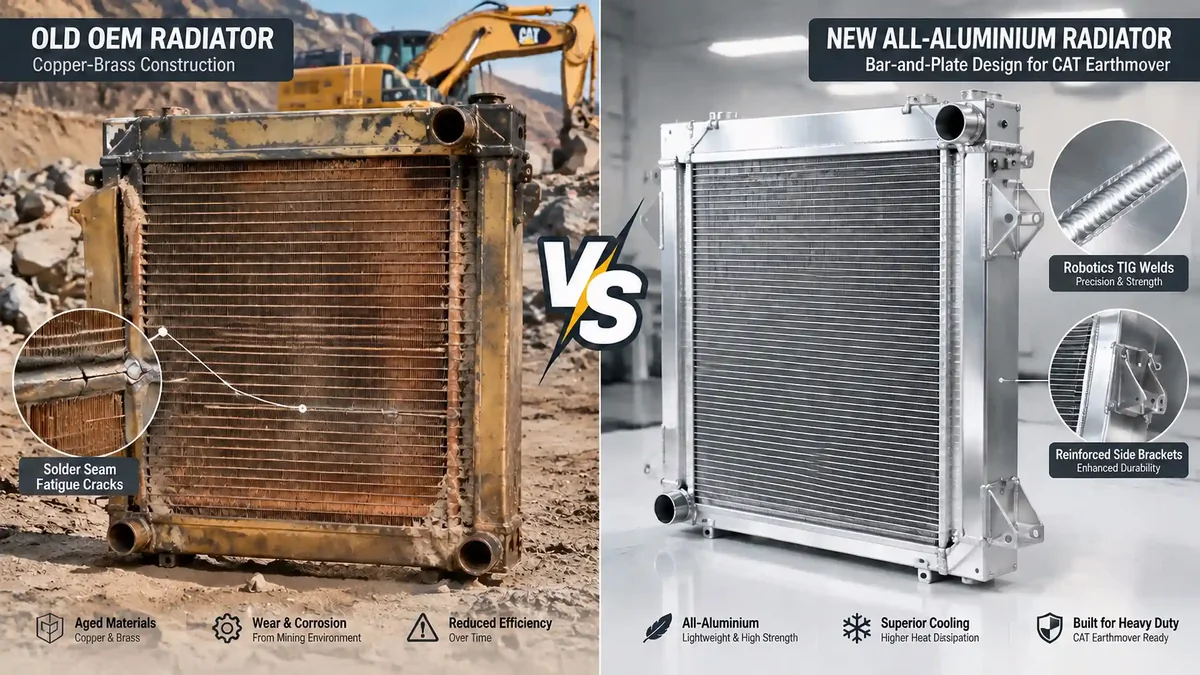
Figure 1: OEM copper-brass radiator compared with a heavy-duty aluminium replacement for a Caterpillar mining excavator.
Quick Answer: Replacing an OEM copper-brass radiator with a heavy-duty aluminium radiator on a CAT excavator comes down to five checks: confirm the actual failure and cooling duty, match the mounting and hose geometry, verify core airflow and heat rejection, control vibration and coolant chemistry, then validate the cooling-system pressure separately from any oil-side pressure. Aluminium is lighter and can be corrosion-resistant, but it has lower thermal conductivity than copper; the replacement core has to earn the same performance through surface area, fin design and airflow.
A copper-brass radiator that has failed in service usually gives a useful clue before it is removed. A leak at the header seam, a cracked tube, corrosion under a mounting bracket and a core blocked with dust are different problems. Replacing the radiator without identifying the failure mode can reproduce it on the new unit.
This is also a machine-fitment job, not just a material comparison. A CAT excavator radiator shares space with the fan, shroud, hydraulic cooler and, on some models, a charge-air cooler. The replacement must match the installation envelope and the cooling duty without disturbing airflow to the other heat exchangers.
Start with the Failure, Not the Part Number
Before ordering a replacement, record where the original radiator failed and what the machine was doing when it failed:
- Coolant loss at the header tank, tube or seam
- External corrosion under a bracket or around a hose connection
- Bent or blocked fins after a dust or mud event
- Vibration cracking at a mounting point
- Overheating that began before the leak appeared
- Pressure-cap, thermostat or water-pump history
This record matters because a new core with the same dimensions can still fail if the root cause is a loose bracket, a damaged fan shroud, a wrong pressure cap or a cooling system that has been running at its limit.
Check 1: Fitment and Cooling Duty
The first check is mechanical interference. Measure the original radiator and compare:
- Core width, height and thickness
- Cross-pin centres and mounting-bracket positions
- Inlet and outlet port diameter, angle and position
- Fan shroud clearance and fan-to-core distance
- Oil cooler or charge-air cooler mounting points
- Hose routing and service access
- Drain, sensor and vent connections
A replacement radiator for Caterpillar / CAT excavator applications should be confirmed against the machine model, serial number, original part number or a measured drawing. “Fits a 320/330/336” is not enough if the machine has a different cooling package or an aftermarket modification.
The thermal duty also has to be checked. Record the engine heat rejection, coolant flow, fan airflow, maximum ambient temperature, altitude and duty cycle. A core that fits but cannot reject the heat will pass a short idle test and fail in the afternoon load cycle.
Check 2: Core Design and Airflow
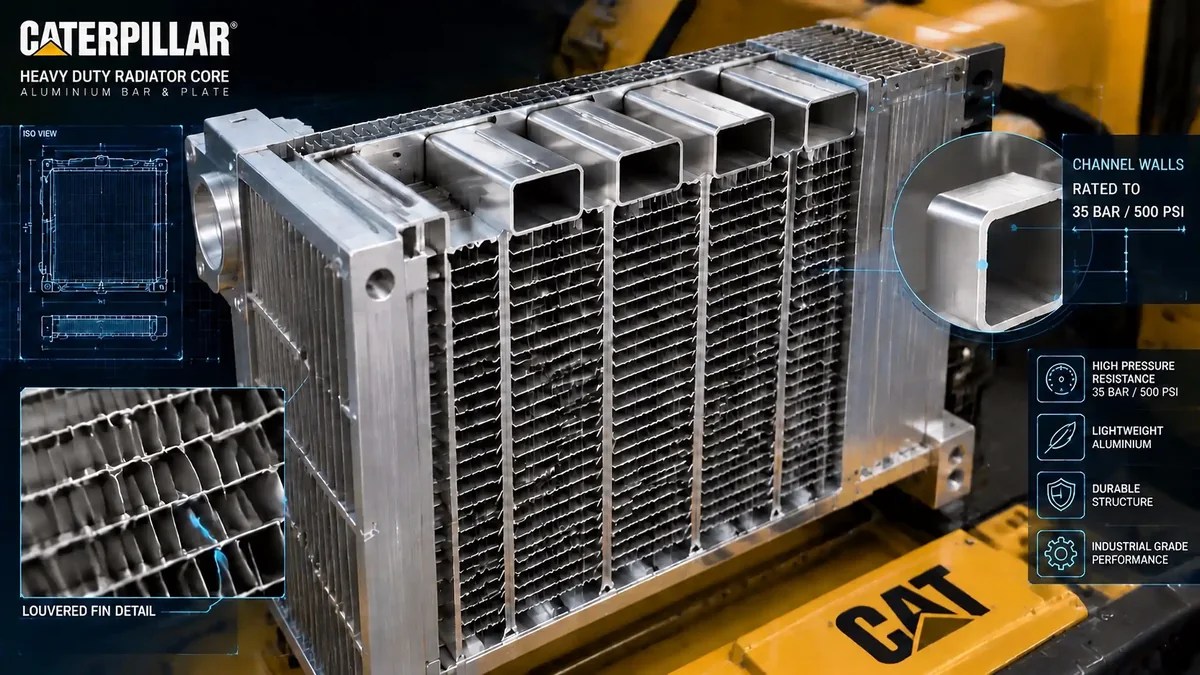
Aluminium does not automatically outperform copper-brass. Copper has higher thermal conductivity, while aluminium is lighter and can be designed with different tube and fin geometry. The replacement core has to compensate through heat-transfer surface, fin density, tube design and airflow.
A bar and plate aluminium radiator core can be a good choice for a heavy-duty or high-vibration application when the design is matched to the duty. A reinforced tube-and-fin core can also be appropriate. The important question is not the marketing name of the core, but whether it delivers the required heat rejection at the available airflow and pressure drop.
Check:
- Net fin area and fin pitch
- Tube thickness and internal flow area
- Air-side pressure drop through the core and shroud
- Fan curve at the actual engine speed
- Recirculation around the radiator and hydraulic cooler
- Dust and cleaning access for the site
If the machine is used in mining or quarrying, an earthmover aluminium radiator needs a core that can tolerate dust, vibration and repeated cleaning. A dense automotive fin pack may cool well on a test bench and clog quickly in the field.
For a combined hydraulic or transmission cooling package, review the heat load separately. A heavy duty equipment oil cooler can share the same airflow path, and a restriction in one core can change the performance of the other.
Check 3: Vibration Isolation and Mounting
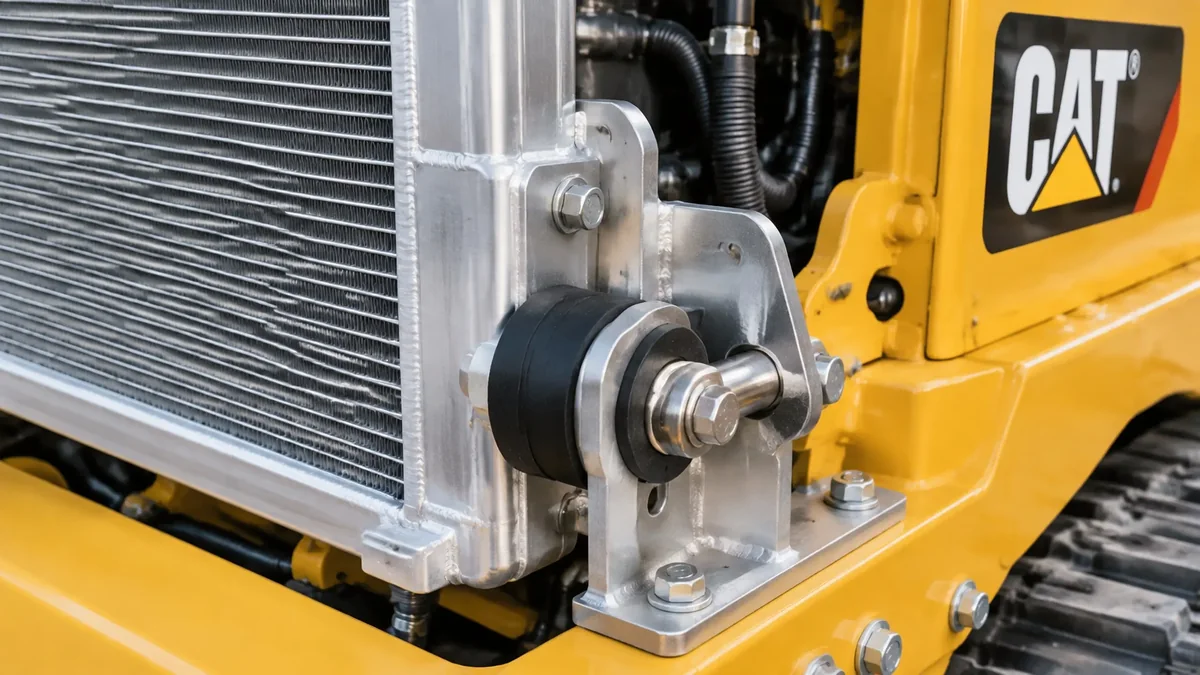
Radiator failures at the header seam or mounting foot often start with relative movement. The replacement should use isolation mounts rated for the machine’s vibration and temperature, not a rigid bracket copied from a stationary application.
EPDM isolation dampeners are common on heavy equipment, but the material must be checked for oil and heat exposure. The bracket bolts, spacers and sleeves should clamp the isolator correctly, and the hose runs should allow movement without pulling on the radiator ports.
Check:
- Isolator material and hardness
- Bracket flatness and bolt torque
- Clearance between the radiator and frame
- Hose support and allowable movement
- Fan shroud attachment and clearance
- Protection from oil, coolant and UV exposure
Check 4: Coolant Chemistry and Corrosion
Aluminium radiators need the correct coolant chemistry. Do not select a coolant only because it is labelled OAT. Confirm the specification for the Caterpillar engine and the materials in the cooling system.
If the machine is changing from a silicate-containing coolant to an OAT coolant, the system needs a proper flush and the correct fill procedure. Mixing coolant types can form deposits or reduce corrosion protection. Check the coolant condition, inhibitor level and any oil contamination before the new radiator is installed.
Also check the coolant filter, water pump, thermostat and pressure cap. A new aluminium radiator will not fix a system that is aerating, running at the wrong pressure or contaminated with debris.
Check 5: Pressure and Validation
Cooling-system pressure and oil-side pressure are separate requirements. A radiator cap on a mobile cooling system often opens around 0.9–1.5 bar, but the exact value and the required pressure test come from the OEM specification. A 35 bar (500 psi) figure belongs to a high-pressure oil or charge-air circuit only when that circuit is designed and tested for it; it is not a generic radiator target.
For a combined radiator and oil cooler, define both pressure boundaries:
| Circuit | What to confirm |
|---|---|
| Engine cooling system | Cap rating, pressure test, burst or cycle test per OEM specification |
| Oil side, if combined | Oil working pressure, pressure-cycle requirement and leak test |
| Charge-air side, if combined | Boost pressure, temperature and pressure-cycle requirement |
| Complete assembly | Mounting loads, vibration, thermal cycling and leak test after assembly |
After installation, bleed the cooling system, confirm fan rotation and shroud clearance, bring the machine to operating temperature and check for leaks under load. A static pressure test alone does not prove the installation is correct.
Installation Checks After the Swap
The first heat cycle is part of the validation, not a formality:
- Confirm the correct coolant concentration and fill procedure.
- Bleed air from the cooling system and check the thermostat opening.
- Verify fan direction, speed and shroud clearance.
- Run the machine at normal load and record coolant and oil temperatures.
- Check hose connections, bracket torque and isolator compression after the heat cycle.
- Recheck coolant level after the system cools.
If the temperature climbs under load after a correct fill and bleed, the core or airflow is not matching the duty. Stop and review the thermal calculation instead of changing the pressure cap or thermostat to mask the problem.
What to Send for a Fit and Thermal Review
A useful replacement review needs more than a machine model:
- Machine model, serial number and original radiator part number
- Photos of the radiator, fan shroud, brackets and hose connections
- Core and mounting dimensions, including cross-pin centres
- Coolant type and system capacity
- Pressure-cap rating and test requirement
- Engine heat rejection, coolant flow, fan speed and airflow
- Ambient temperature, altitude and dust condition
- Oil-side duty if the radiator is combined with a heavy duty equipment oil cooler
- Required delivery date and quantity
Our team can review a CAT excavator replacement radiator, an excavator cooling package or a plate-fin hydraulic oil cooler against the measured envelope and duty. For the thermal side, the bar and plate oil cooler sizing guide shows the calculation inputs we need.
FAQ
Can I replace a copper-brass radiator with an aluminium radiator on a CAT excavator?
Yes, if the replacement matches the cooling duty and installation envelope. The core, airflow, mounting, coolant and pressure requirements must be checked together; an aluminium radiator is not a like-for-like material swap.
Does aluminium cool as well as copper-brass?
Aluminium has lower thermal conductivity than copper, but a well-designed aluminium core can meet the same heat rejection through greater surface area, fin geometry and airflow. The actual performance must be verified from the core design and machine duty.
What pressure should a CAT excavator radiator be tested to?
Use the pressure specified for the machine and cooling system. Many radiator caps operate around 0.9–1.5 bar, but the exact cap rating, test pressure and burst or cycle requirement must come from the OEM specification. A 35 bar figure is not a generic radiator requirement.
Can I change to OAT coolant during the radiator replacement?
Only after confirming the coolant specification for the engine and machine. OAT coolant is not automatically compatible with every system, and mixing coolant types can create deposits or corrosion. Flush and refill according to the OEM procedure.
How do I confirm a CAT replacement radiator will fit?
Send the machine model, serial number, original part number and photos of the radiator, fan shroud, mounting points and hose connections. The supplier should verify the envelope and connections before production.
Need a CAT Radiator Fit and Duty Review?
Send the machine model, serial number, original part details and photos. We will compare the mounting envelope, airflow path, coolant requirements and pressure specification before quoting a heavy-duty aluminium replacement.
Request a CAT Excavator Radiator Review
Need Help Selecting an Oil Cooler?
Send us your specs or drawings and our engineers will size the right cooler for you within 24 hours.
Get a Free Quote Chat on WhatsApp