
2026-11-05
How to chemically descale industrial plate-fin radiators without etching aluminum joints?
Chemical descaling of an aluminum plate-fin radiator is a controlled compatibility job, not a generic acid flush. This guide covers deposit identification, AA4004 brazed-joint risk, inhibited acid circulation, neutral rinsing and post-clean verification.
Quick answer: Chemical descaling of an aluminum plate-fin radiator must begin with the deposit, the exact alloy and the OEM's approved cleaning procedure. Hydrochloric or sulfuric acid should not be used as a generic aluminum radiator cleaner. If a qualified inhibited sulfamic or citric-acid product is approved, a controlled trial may use an example window of 5–8% cleaner, 40–50°C and pH 3.5–4.5, but those values are not universal. BTA is primarily a copper-corrosion inhibitor, not a buffer. After circulation, neutralise and rinse immediately, then use only an OEM-approved drying or passivation step.
- Scale chemistry decides the cleaner. Calcium carbonate, sulfate scale, silica, iron oxide and hydrocarbon fouling do not respond to the same chemistry.
- AA4004 is a braze-clad system. Acid attack can remove aluminum preferentially and leave a weak silicon-rich surface.
- pH alone does not define corrosion risk. Free acid, chloride, temperature, time, inhibitor strength and dissolved metals also matter.
- The post-clean rinse is part of the process. Neutral pH is not enough if aggressive salts remain in the core.
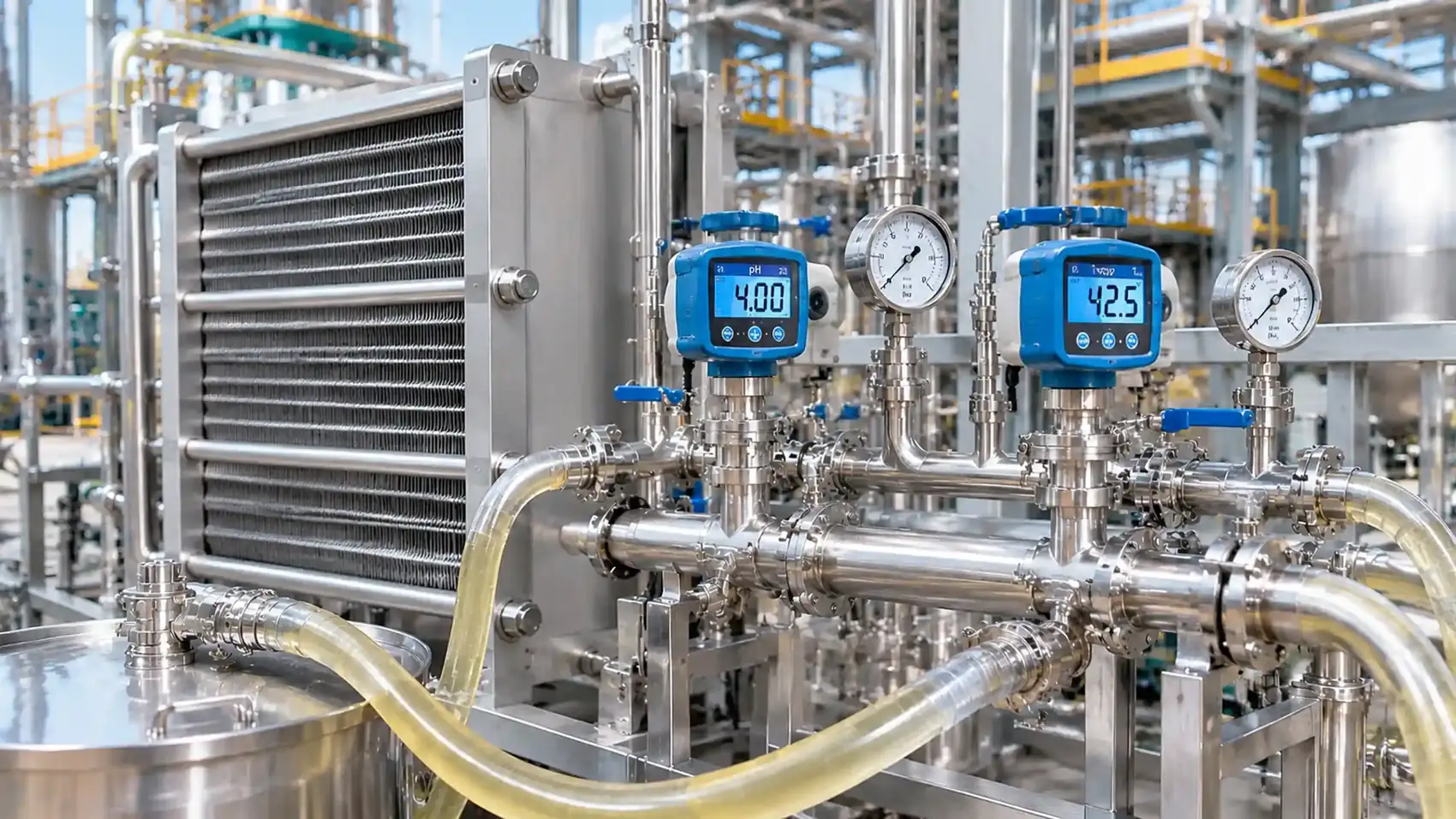
Identify the deposit before selecting an acid
The first mistake is treating every white or brown deposit as calcium scale. A plate-fin radiator used in a cooling-water circuit may contain:
- Calcium carbonate or calcium sulfate scale
- Iron oxide or corrosion products from a steel circuit
- Silica, clay or suspended solids
- Oil, biofilm or hydrocarbon fouling
- Aluminum corrosion products and gel-like oxide
- Residual brazing flux or process contamination
An acid that dissolves calcium carbonate may not touch silica. A solvent that removes oil may not dissolve mineral scale. Mechanical brushing, high-pressure water, chelating chemistry and acidic descaling are different operations and should not be mixed without checking access and material compatibility.
For an internal water-side deposit, ask for a water analysis and a small scale sample. For an external air-side deposit, first identify whether the material is dust, oil-soaked dust, corrosion product or a chemical precipitate. The air-side fins are thin and easy to deform, so a cleaning method that works on a heavy tube wall may still damage the fin pack.
The compressed-air aftercooler troubleshooting guide covers system-level symptoms that can mimic a blocked heat exchanger. Confirm the problem is actually scale before introducing chemicals.
What AA4004 means at a brazed joint
AA4004 is an aluminum-silicon-magnesium brazing-clad alloy. It is not a protective coating painted onto the finished core. During vacuum brazing, the clad layer melts, flows into the joint and interacts with the base material. The final fillet has a silicon-rich eutectic structure and a diffusion zone, so its corrosion behaviour cannot be inferred from the nominal AA4004 composition alone.
An aggressive acid can attack the aluminum-rich phase preferentially. The joint may become visually rough while the silicon network remains standing. That surface can look “cleaned” but have less effective load-bearing section. The same acid can also expose a fresh aluminum surface that oxidises or pits during an inadequate rinse.
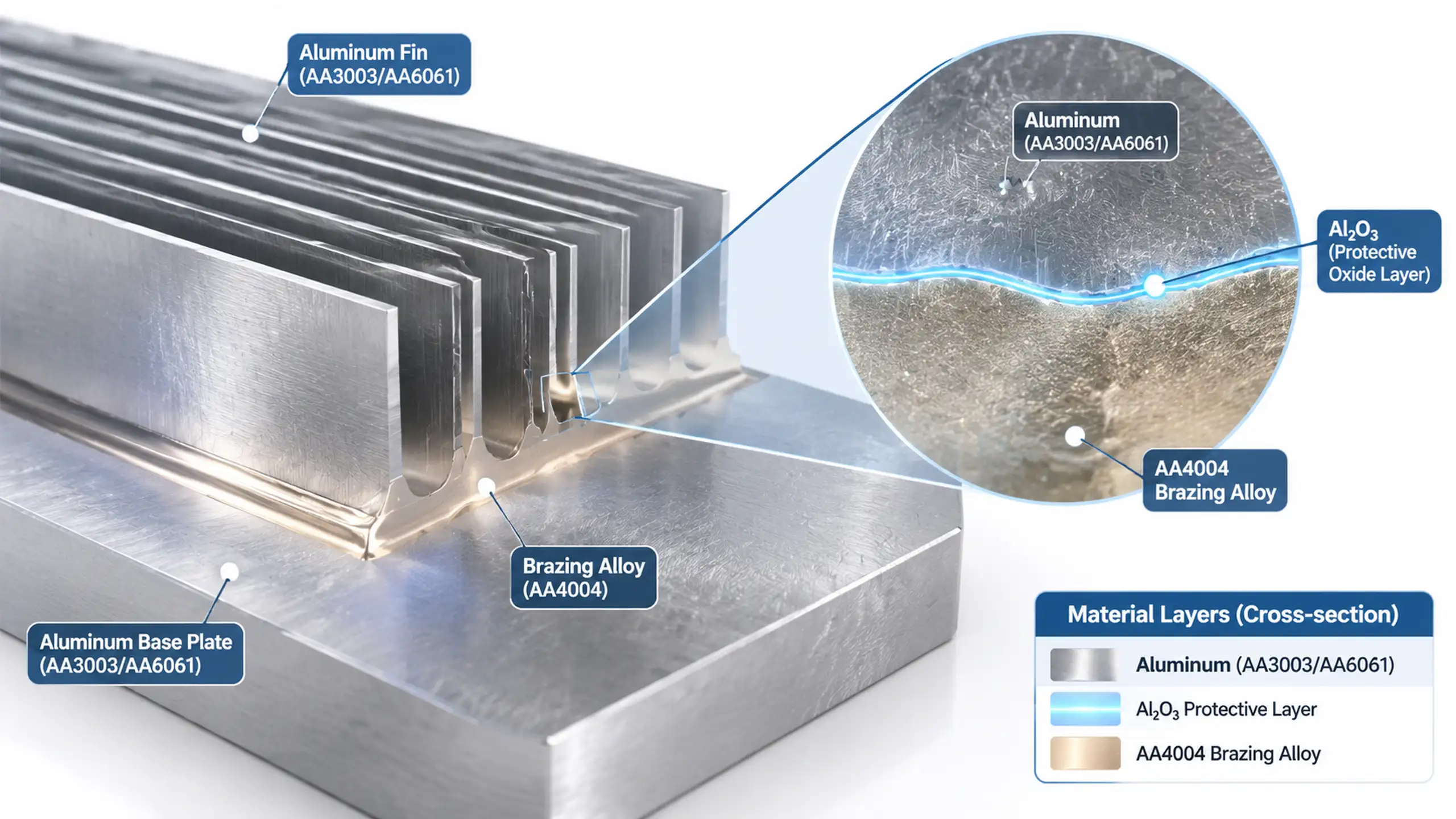
The risk is not limited to the visible braze fillet. The tube-to-header joint, fin-to-tube bond and any exposed clad surface can be affected. A cleaner that passes a short coupon test but remains trapped in a narrow fin passage can continue attacking the metal after the pump stops.
A controlled cleaning sequence
The following sequence is a framework for a qualified procedure. It is not a recipe that can be used without the radiator OEM's approval.
1. Isolate and document the circuit
Record the fluid, water chemistry, operating temperature, pressure, flow and the reason for cleaning. Isolate the radiator and confirm that it is not already leaking. A leaking core should not be connected to a circulating chemical loop and treated as a scale problem.
2. Establish a compatible circulation loop
Use a vented, contained loop with:
- Temperature measurement and independent over-temperature protection
- Flow and pressure indication below the radiator's allowable limits
- A strainer or filter to capture released scale
- Sample points before and after the radiator
- A drain and neutralisation route approved for the cleaning chemicals
- Ventilation and PPE appropriate to the acid and any gas produced
Do not use chlorinated water for the rinse or make-up. Chloride is a pitting risk for aluminum, especially when the surface has been freshly cleaned.
3. Qualify the chemical on a coupon
The cleaner supplier should provide a technical data sheet, safety data sheet, recommended concentration range, contact time, temperature limit, chloride content and inhibitor information. Obtain a written compatibility statement for the exact core materials, braze alloy and any gasket or coating in the circuit.
A weighed coupon of AA4004 braze clad and the base alloy should be exposed under the proposed conditions. Record mass loss, surface appearance, pH drift, temperature and rinse behaviour. The acceptance criterion should be set before the test; “looks acceptable” is not a corrosion specification.
4. Circulate under measured limits
The source proposal gives an example window of 5–8% inhibited sulfamic acid or citric acid, 40–50°C and pH 3.5–4.5. Treat this only as a qualification window for a formulated product. The minimum effective concentration and maximum allowable temperature must come from the chemical supplier and the radiator OEM.
During circulation, monitor:
| Parameter | Why it matters |
|---|---|
| Cleaner concentration | Low concentration may stop working; high concentration increases attack |
| pH | Shows acid strength but not the complete corrosion risk |
| Temperature | Reaction rate and inhibitor performance change with temperature |
| Flow and pressure | Low flow leaves stagnant zones; high pressure can load weak joints |
| Chloride and oxidiser content | Both can promote aluminum pitting |
| Dissolved aluminum, iron and silicon | Indicates active metal attack or scale release |
| Contact time | An overrun turns a controlled clean into an etching step |
| Return-stream appearance | Sudden colour or particles can signal a change in attack |
pH 3.5–4.5 is not a safety certificate. Two solutions with the same pH can behave differently because one may have more free acid, a stronger chelating action, a different inhibitor or a higher chloride content. Temperature and contact time can be more important than the pH number once a threshold is crossed.
5. Neutralise and rinse to a measured endpoint
Stop the acid circulation when the agreed chemical or time limit is reached. Drain the acid to a compatible waste system and neutralise it according to the chemical supplier's instructions. Do not neutralise the whole loop while the radiator is still full of acid unless that procedure has been approved for the radiator materials.
Rinse with low-conductivity water until the return water meets the project's pH and conductivity endpoints. The exact endpoint depends on the site water and OEM requirement, but the principle is consistent: clear, near-neutral rinse water with low residual salts. A neutral pH reading does not prove that chloride or silicate has been removed.
6. Dry and verify the core
Dry with clean, oil-free air if the OEM permits. Do not leave standing water in the fins or headers. Inspect accessible surfaces and perform the agreed checks:
- Pressure decay or hydrostatic test at the approved pressure
- Helium leak test where high-integrity joints are required
- Flow and pressure-drop comparison with the pre-clean baseline
- Thermal performance at a controlled load
- Visual inspection for loose particles, roughness or bright etched areas
The vacuum-brazing versus CAB comparison explains why brazed-joint quality and leak testing cannot be judged from appearance alone. If the radiator is already showing internal leakage, use the micro-leak diagnostic guide before deciding whether cleaning is still useful.
The difference between an inhibitor, a buffer and a passivator
These terms are often mixed in cleaning proposals:
- Inhibitor: reduces corrosion by forming a protective film or changing the electrochemical reaction. It must be matched to the alloy and chemistry.
- Buffer: resists a change in pH but does not necessarily prevent localized corrosion.
- Passivator: promotes or restores a protective oxide or conversion layer. The treatment must be proven for the alloy and application.
Benzotriazole is principally a copper-alloy corrosion inhibitor. It is not a pH buffer, and it should not be presented as a complete aluminum passivator. If a formulation contains BTA, ask what aluminum-specific inhibitor is present and how its film survives the rinse.
Sodium silicate can form a silica-rich film in some systems, but it can also leave deposits that block narrow passages. Triethanolamine can neutralise acid and provide some corrosion inhibition, but it does not automatically rebuild an Al₂O₃ layer. A claim that either chemical “restores the native oxide” should be supported by a specific process, concentration, temperature and surface test.
Choose the cleaner from the deposit, not the colour of the water
| Deposit or condition | What to consider | What to avoid |
|---|---|---|
| Calcium carbonate scale | A qualified inhibited acidic descaler may be evaluated | Uninhibited strong acid or an unverified field mix |
| Calcium sulfate or silica | Acid alone may be ineffective | Repeated acid circulation with no deposit confirmation |
| Iron oxide or mixed corrosion product | Chelating or reducing/cleaning chemistry may be needed | Assuming a white deposit is calcium scale |
| Oil or biofilm | Degrease and remove organic fouling first | Acid circulation through an oil-covered core |
| Aluminum oxide gel or white corrosion product | Confirm whether removal is necessary and safe | Abrasive cleaning or aggressive acid attack |
| Unknown deposit on an unknown alloy | Stop and identify both | A generic “aluminum cleaner” trial |
The bar-and-plate oil cooler sizing guide is useful when the real problem is insufficient heat-transfer area or oil flow, not internal scale. Cleaning cannot compensate for a cooler that was undersized from the start.
System causes that bring the scale back
A successful clean is temporary if the water chemistry is not corrected. Review make-up water hardness, pH, dissolved oxygen, suspended solids, corrosion-product transport, dead legs, filtration and inhibitor control. For a closed loop, check the original water treatment and any recent make-up or process contamination. For an open circuit, check evaporation, carryover and filtration.
The operator should record the cleaned radiator's baseline flow, pressure drop and approach temperature. A follow-up reading after the system has stabilized tells you whether the cleaning worked and whether the water treatment is holding. A short-lived temperature improvement usually points back to the circulating system rather than the cleaning procedure itself.
For a replacement or custom assembly, review the custom OEM oil cooler route and the industrial machinery cooling page. The material, braze process, water-side chemistry and cleaning access should be defined together.
FAQ
Can hydrochloric or sulfuric acid be used to descale an aluminum plate-fin radiator?
Not as a general practice. Chloride-bearing acids can initiate pitting, and strong acid attack can dissolve aluminum and the braze-clad surface. Use them only if the radiator OEM and a qualified chemical supplier provide a documented, inhibited procedure for that exact assembly.
Is 5-8% inhibited sulfamic acid at pH 3.5-4.5 universally safe for AA4004?
No. Those values are a qualification window used in some formulated aluminum cleaners, not a universal recipe. Safety depends on the exact inhibitor package, chloride content, temperature, circulation time, free acid, deposit load and the radiator's alloys and coatings.
Is benzotriazole a pH buffer or an aluminum passivator?
BTA is primarily a corrosion inhibitor for copper and copper alloys. It is not a pH buffer and is not a complete aluminum passivation system. Any aluminum-specific inhibitor or buffer must come from the cleaner formulation and be verified with the OEM.
Does sodium silicate or triethanolamine restore the Al2O3 layer?
Do not assume so. Sodium silicate can leave a silica-rich film or deposit, and triethanolamine is mainly a neutralizer or corrosion-inhibiting amine. The radiator may re-oxidize naturally after proper rinsing and drying, but any claimed passivation treatment must be approved for the specific system.
How can I tell whether the brazed joints were etched during cleaning?
Check for a bright, rough or silicon-rich surface, abnormal colour, loose particles, changed dimensions or new leaks. Verify with pressure decay, helium leak testing, flow and thermal performance. For critical joints, a destructive coupon or cross-section is more reliable than visual inspection.
When should a scaled radiator be replaced instead of chemically cleaned?
Replace or repair it when a leak or wall loss is confirmed, the alloy and braze system are unknown, the deposit cannot be removed without aggressive chemistry, or repeated blockage points to a system-level water-treatment problem.
Need a cleaning procedure checked against the actual radiator?
Send the radiator drawing, alloy and braze details, water chemistry, deposit photos, current flow and pressure drop, and the proposed cleaning chemicals. Our engineers can review the compatibility and replacement route before a cleaning trial is approved.