
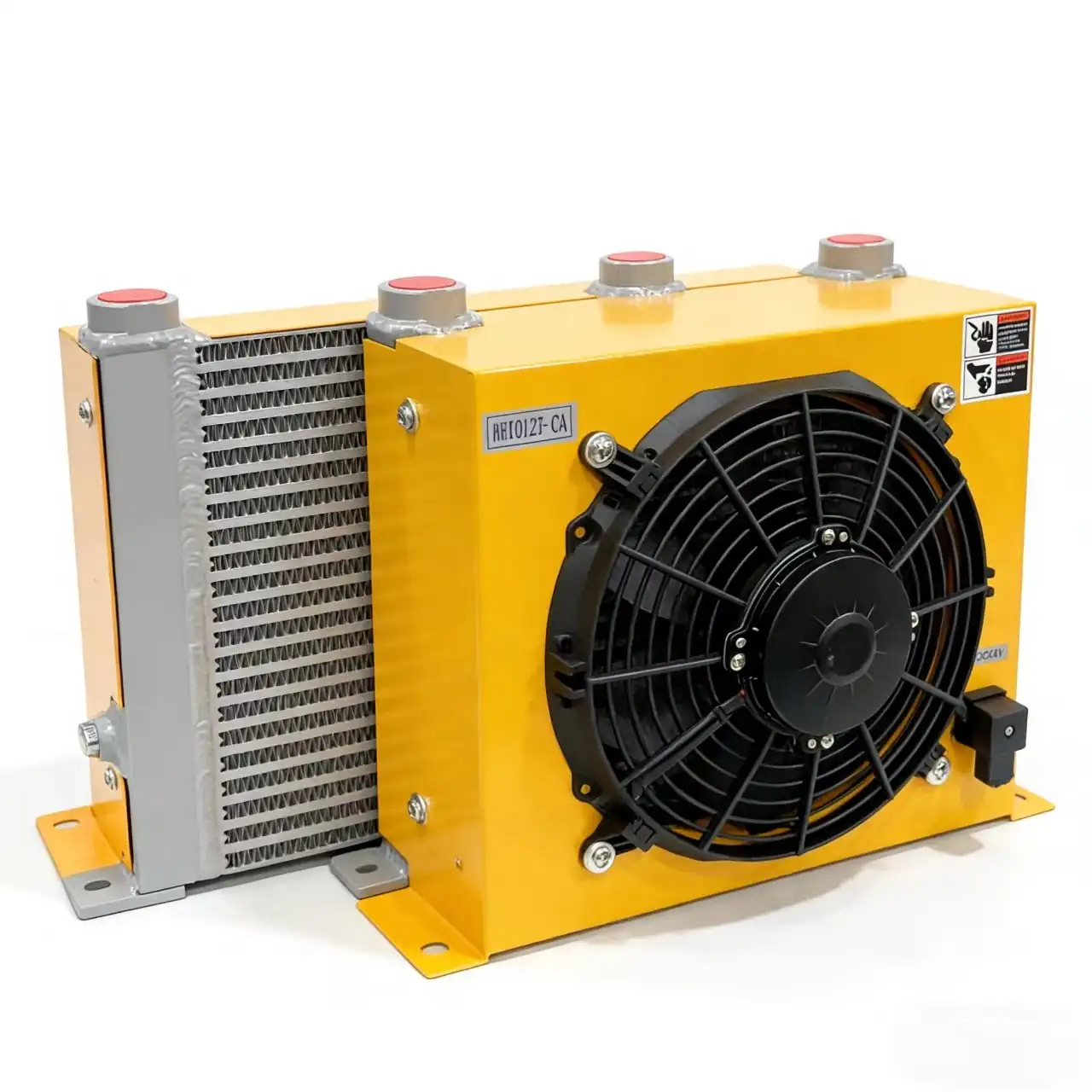
Keep Hydraulic Oil Cool Under Load
A hydraulic oil cooler with a matched 12V or 24V cooling fan removes heat from the oil circuit of excavators, wheel loaders, tractors and other agricultural machinery. Hot oil flows through a finned aluminum core, the fan blows air across the fins, and the cooled oil returns to the tank at a safe working temperature.
We are a heavy-duty hydraulic oil cooler manufacturer - every unit is engineered to your machine's envelope, mounting space and duty, then built and tested in our own factory.
Key Features & Benefits
- Heavy-duty bar-and-plate core: vacuum-brazed aluminum core delivers maximum cooling in a compact, rugged package.
- Matched 12V / 24V fan: DC fan selected for the machine's electrical system, with thermostatic control options.
- Custom fit: mounting brackets, ports and envelope built to your machine - non-standard is our standard.
- Dust-resistant fins: designed for job-site and field conditions on construction and farm equipment.
- 100% pressure tested: every cooler tested before shipment, with test reports available.
Product Specifications
| Parameter | Typical Range |
|---|---|
| Cooling capacity | 5 - 200 kW (custom) |
| Oil flow rate | 20 - 500 L/min |
| Maximum working pressure | up to 2.5 MPa |
| Fan voltage | 12V / 24V DC |
| Core type | Vacuum-brazed aluminum bar-and-plate |
| Connections | G threads, SAE, flanged or custom |
How It Works
- Hot hydraulic oil enters the cooler from the return line or power unit.
- Oil flows through the bar-and-plate core, and heat transfers to the fins.
- The 12V or 24V fan blows air across the fins, carrying the heat away.
- The cooled oil returns to the tank at a safe working temperature.
Applications & Aftermarket
Heavy-duty hydraulic oil coolers are used on excavators, wheel loaders, bulldozers, tractors, harvesters and other construction and agricultural machinery. We also supply aftermarket replacement coolers compatible with major brands - a fast, cost-effective alternative to OEM parts, built to the original envelope and duty. Use the bar and plate oil cooler sizing guide to confirm the heat load, LMTD and required area before selecting the fan and core.
We also supply cooling for related machines: excavator coolers, bar and plate aluminum oil cooler assemblies and industrial hydraulic oil coolers.
Custom & OEM Manufacturing
Send us your machine model, drawing or duty parameters. We confirm the design and quotation within 24 hours, make a prototype for evaluation, then produce with full testing. See our custom process or contact us.
How to Size a Hydraulic Oil Cooler with a 12V/24V Fan
A hydraulic cooler should be selected from the heat load and the allowable oil temperature, not from the physical size of the old cooler alone. The main inputs are:
- Hydraulic oil flow rate
- Heat load generated by pumps, motors and valves
- Maximum allowable oil temperature
- Ambient air temperature
- Required outlet temperature
- Allowable pressure drop
- Available installation space
- Fan voltage and available electrical power
The cooler must remove the heat added by inefficiency in the hydraulic system. If the machine operates continuously at high load, the fan and core must be sized for that sustained condition rather than a short peak. A unit that looks suitable on a warm day may become undersized in high ambient temperature, at altitude or when the oil has become more viscous.
For an existing machine, send the original cooler dimensions, oil flow, working temperature and photos. We can compare the failed or undersized unit with the required duty and propose a replacement envelope.
Choosing 12V or 24V Fan Control
Most mobile machines use a 12V or 24V DC fan because the machine already provides that electrical system. The fan choice must consider:
- Nominal system voltage
- Fan current draw and starting current
- Alternator or battery capacity
- Fuse and relay rating
- Airflow at the actual installed pressure drop
- Dust, mud and vibration exposure
- Required IP or protection level
A simple on/off fan is suitable for some systems. A thermostat or temperature switch can start the fan only when cooling is needed. Where the load changes frequently, a PWM or variable-speed controller can reduce noise, electrical demand and fan wear while maintaining a more stable oil temperature.
The fan should be matched to the core, not added as an afterthought. More fan power cannot compensate for a core with excessive pressure drop or poor airflow distribution.
Installation and Airflow
Install the cooler where clean air can enter the core and hot air can leave without recirculating. Keep the fan guard, hydraulic hoses and mounting brackets from blocking the effective core area. If the machine operates in dust or crop residue, use a serviceable guard and provide enough clearance for cleaning.
Use flexible hoses or correctly designed piping to prevent engine vibration and chassis movement from loading the cooler connections. Mount the assembly with vibration isolators where required, and avoid over-constraining the core through multiple rigid brackets.
For mobile equipment, confirm:
- Fan rotation and airflow direction
- Clearance around the fan blade
- Protection from reverse airflow during travel
- Drainage for water and cleaning fluid
- Access to the core without removing the hydraulic circuit
- Protection of electrical cables and connectors
Maintenance Checklist
- Inspect the core and fan guard for dust, mud and crop residue.
- Clean the fins with low-pressure air or water in the direction recommended for the installation.
- Check fan blades for damage, imbalance and excess play.
- Inspect electrical connectors, fuses, relays and control sensors.
- Confirm that oil flow and pressure drop remain within the design range.
- Check hoses and flange connections for seepage or movement.
- Record oil temperature under the same load and ambient condition so trends become visible.
If oil temperature continues to rise after cleaning, the problem may be heat load, oil viscosity, internal leakage or an undersized cooler rather than a dirty core. Review our hydraulic oil temperature guide for troubleshooting context.
Facing overheating issues in your hydraulic system? Send us your specs or drawings - our engineers will size the right cooler for you within 24 hours.