
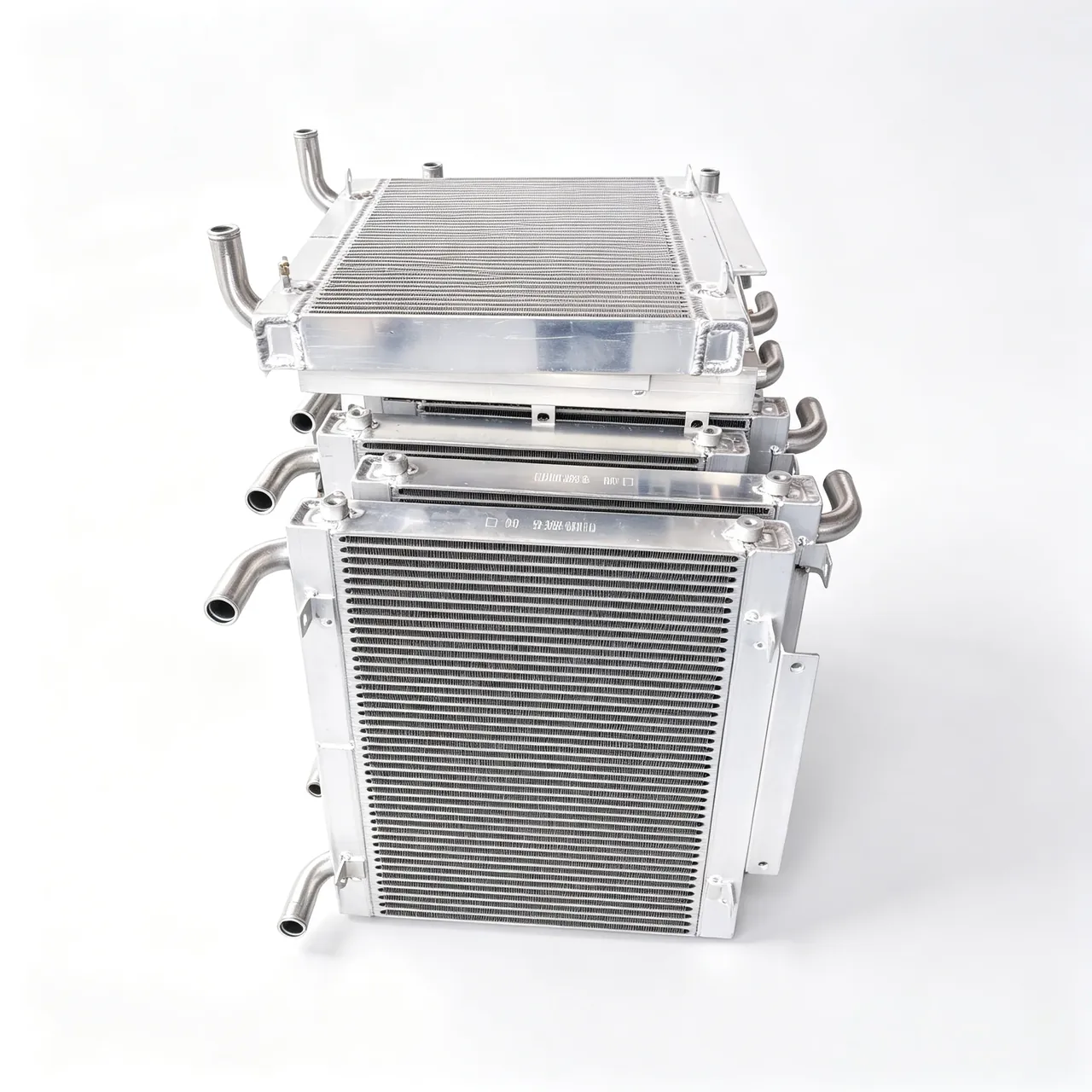
What Is a Plate-Fin Compressed Air Cooler?
A plate-fin compressed air cooler is an air-cooled heat exchanger that lowers the temperature of compressed air after the compression stage. It uses a vacuum-brazed aluminum plate-fin core and a fan to pull heat out of the discharge, protecting downstream dryers, filters and tools from high temperature and moisture.
We are a custom compressed air cooler manufacturer - every unit is engineered to your compressor's air flow, pressure and heat load, then built and tested in our own factory.
Custom Aluminum Plate-Fin Compressed Air Cooler
Industrial Aftercooler for Compressor Systems. Our custom aluminum plate-fin compressed air coolers deliver maximum heat rejection in a compact, rugged package. The vacuum-brazed plate-fin core creates strong, leak-free joints and handles the pressure pulses of continuous compressor duty.
- Core Technology: Vacuum Brazed Aluminum Plate-fin
- Applications: Screw and reciprocating air compressors, industrial plants, and compressed air systems
- Custom Design: Sized to your compressor's flow, pressure and heat load, with custom ports and mounting
Product Specifications
| Parameter | Typical Range |
|---|---|
| Core type | Aluminum plate-fin, vacuum brazed |
| Cooling capacity | 1 - 500 kW (custom) |
| Air flow rate | 10 - 1000 L/min (custom) |
| Maximum working pressure | up to 2.5 MPa |
| Fan voltage | 12V / 24V DC, 110V / 220V / 380V AC |
| Connections | G threads, SAE, flanged or custom |
How It Works
- Hot compressed air leaves the compressor and enters the plate-fin cooler.
- The air flows through the core, and heat transfers to the plates and fins.
- A fan blows air across the fins, carrying the heat away.
- The cooled discharge leaves at a safe temperature, ready for drying, filtering or downstream use.
Applications & Aftermarket
Plate-fin compressed air coolers and industrial aftercoolers are used on screw and reciprocating compressors in factories, workshops and industrial plants. If your original aftercooler is discontinued, we manufacture a replacement compressed air cooler from your drawing or old part - a fast, cost-effective alternative to OEM parts.
Custom & OEM Manufacturing
Send us your compressor model, drawing or duty parameters. We confirm the design and quotation within 24 hours, make a prototype for evaluation, then produce with full testing. See our custom process or contact us.
Aftercooler vs Intercooler: What Is the Difference?
A compressed air aftercooler is installed after the final compression stage. Its job is to reduce the discharge temperature before the air enters a receiver, dryer, filter or distribution network. An intercooler is normally installed between compression stages to reduce the air temperature before the next stage.
Both use a heat exchanger, but the operating pressure, airflow, allowable pressure drop and moisture load can be different. Specify the location of the cooler and the complete compressor package rather than ordering by the name alone.
Compressed Air Cooling and Dew Point
Cooling compressed air reduces its ability to hold water vapor. When the air temperature falls below the pressure dew point, condensation forms. The cooler itself does not remove all moisture; a separator, drain and dryer are still required downstream.
The cooler outlet temperature should be selected together with the dryer and receiver design. If the air leaves the cooler too warm, the dryer may be overloaded. If it is cooled excessively without proper drainage, condensate can collect in the core or pipework and create corrosion or freezing risk. For diagnosis, see the compressed air aftercooler water carryover guide.
What Determines Cooler Performance
The heat exchanger must be sized using the actual compressor duty:
| Input | Why it matters |
|---|---|
| Inlet air temperature | Determines the heat load entering the cooler |
| Air flow rate | Controls velocity and heat-transfer performance |
| Working pressure | Affects density and pressure-containing design |
| Ambient temperature | Determines the available cooling-air temperature |
| Fan airflow | Removes heat from the fins |
| Allowable pressure drop | Protects compressor efficiency and downstream pressure |
| Required outlet temperature | Must match dryer and receiver requirements |
| Fouling and moisture load | Affects long-term performance and cleaning interval |
A cooler sized only by pipe size may pass a short test but fail during continuous operation. Ask for the thermal calculation assumptions and pressure-drop data at the operating point.
Pressure Drop and Condensate Drainage
Excessive pressure drop wastes compressor energy and reduces available pressure downstream. The acceptable limit depends on the compressor package and total system pressure budget. Keep the cooler connections, internal passages and piping as direct as practical, and avoid unnecessary elbows or reductions.
Condensate must be able to leave the cooler without re-entering the air stream. Consider:
- A separator immediately downstream of the cooler
- A properly sized automatic drain
- Piping arranged to drain by gravity
- Protection against freezing
- Access for inspection and cleaning
Installation and Maintenance
Install the cooler where cool ambient air can reach the core and hot discharge air can escape. Keep the fan guard, pipework and structural members from blocking airflow. Confirm that the core can be inspected and cleaned without dismantling the compressor package.
Maintenance should include:
- Checking the fan and electrical connections
- Cleaning the fins according to the contamination level
- Inspecting drains and separators
- Recording pressure drop and outlet temperature
- Checking pipe supports and flange connections
- Looking for moisture, oil carryover or corrosion
For related systems, review our air-cooled oil cooler, OEM compressor aftercooler replacement and vacuum pump radiator.
Need a plate-fin compressed air cooler for your compressor? Send us your specs or drawings - our engineers will size it for you within 24 hours.