
2026-11-01
Why do wind turbine gearbox oil coolers burst during low-temperature cold starts?
A wind turbine gearbox oil cooler usually bursts when cold, high-viscosity oil produces more pressure drop than the bypass, relief valve and core can safely manage. Check the oil's low-temperature data and log the actual cold-start pressure before selecting a replacement.
Quick answer: a cold-start cooler burst is a pressure event, not simply a cold-temperature event. Low temperature raises oil viscosity and pressure drop, but the core is damaged only when the pump, bypass valve, relief valve and pressure envelope combine to expose it to more pressure than the brazed structure can withstand.
- Oil viscosity: high viscosity increases flow resistance, especially in narrow bar-and-plate passages.
- Bypass response: a thermal or pressure bypass that remains closed or opens too slowly sends full cold-oil flow through the cooler.
- Relief protection: a blocked, wrongly set or undersized relief valve may allow pressure to exceed the core rating.
- Core qualification: proof, burst and fatigue ratings must match the actual cold-start pressure transient.
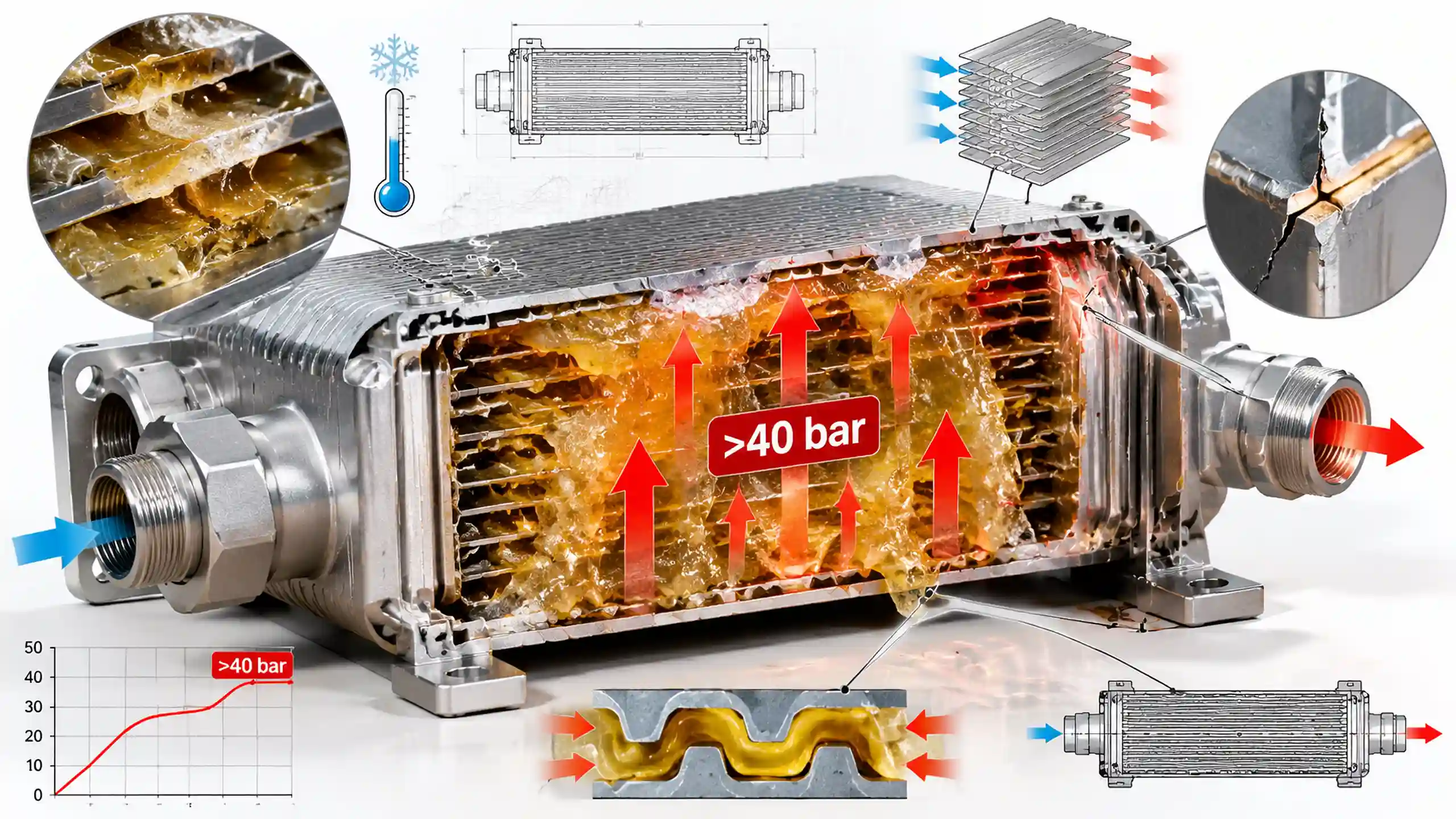
Why cold oil creates a pressure problem
For a fixed flow path and pump displacement, pressure drop rises strongly as viscosity increases. In the simplified laminar-flow regime:
pressure drop ∝ viscosity × flow
That relationship is not a complete design equation, but it explains the field behavior: oil that flows easily at normal operating temperature can create a much larger pressure differential during a cold start.
A positive-displacement pump does not simply reduce flow when resistance rises. It continues to displace oil until the relief path opens or something in the circuit deforms. A cooler that is thermally adequate at 40°C can therefore see a pressure transient far outside its normal operating condition at -20°C.
ISO VG 320 is not a low-temperature viscosity specification
ISO VG 320 describes a viscosity grade at 40°C. It does not tell you the viscosity at -20°C or the oil's pour point. Two oils with the same ISO grade can behave differently at low temperature because of base-oil composition, viscosity index and additive package.
Request the actual oil data:
- Viscosity at the minimum start temperature
- Pour point
- Viscosity index
- Low-temperature pumping behavior
- Compatibility with the gearbox seals and materials
- Recommended warm-up procedure
If the oil is near its pour point, it may channel, gel or fail to circulate properly. In that condition, the cooler may be full of cold oil while the pump outlet pressure rises. The pressure sensor location matters: a reading at the pump may not show the differential across the cooler.
Check bypass and relief protection together
There are two different protections in many gearbox cooling circuits:
- Thermal bypass: opens as oil temperature rises, allowing oil to flow through the cooler only after warm-up.
- Pressure bypass or relief: limits the pressure developed by the pump or protects the cooler from an excessive differential.
They are not interchangeable. A thermal bypass that stays closed during a cold start can expose the core to full flow. A pressure relief valve that is blocked, wrongly adjusted or too small may not relieve the transient fast enough.
Inspect the complete protection path:
| Component | What to verify |
|---|---|
| Thermal bypass | Opening temperature, travel, spring and seal condition |
| Pressure bypass | Cracking pressure, response time and return to closed position |
| Relief valve | Set pressure, capacity, pilot line and blockage |
| Pump control | Start-up speed, unloading or soft-start logic |
| Oil heater | Capacity, thermostat and temperature distribution |
| Instrumentation | Sensor location, range, response time and logging interval |
A single pressure gauge read after the start is not enough. Log the first seconds and minutes of a cold start to capture the transient peak.
How the core actually fails
A braze joint does not need to see a sustained 40 bar for hours to fail. A short pressure spike can be enough if it exceeds the local strength of the core or opens a crack that grows under later thermal and pressure cycles.
Typical failure locations include:
- Braze fillet at the core-to-header joint
- Tube-to-header connection
- Internal bar-to-plate joint
- Side plate or bracket transition
- Port boss and flange weld
- Seal or gasket extrusion path
The failure may appear as a leak first and a visible rupture later. A pressure test after a cold-start event should include the cooler inlet, outlet and any external bypass circuit, not only the pump outlet.
The source material uses 40 bar (580 psi) as an example of a severe transient. That value may be relevant to a particular circuit, but it is not a universal burst threshold for every bar-and-plate cooler. Confirm the actual design and qualification pressures.
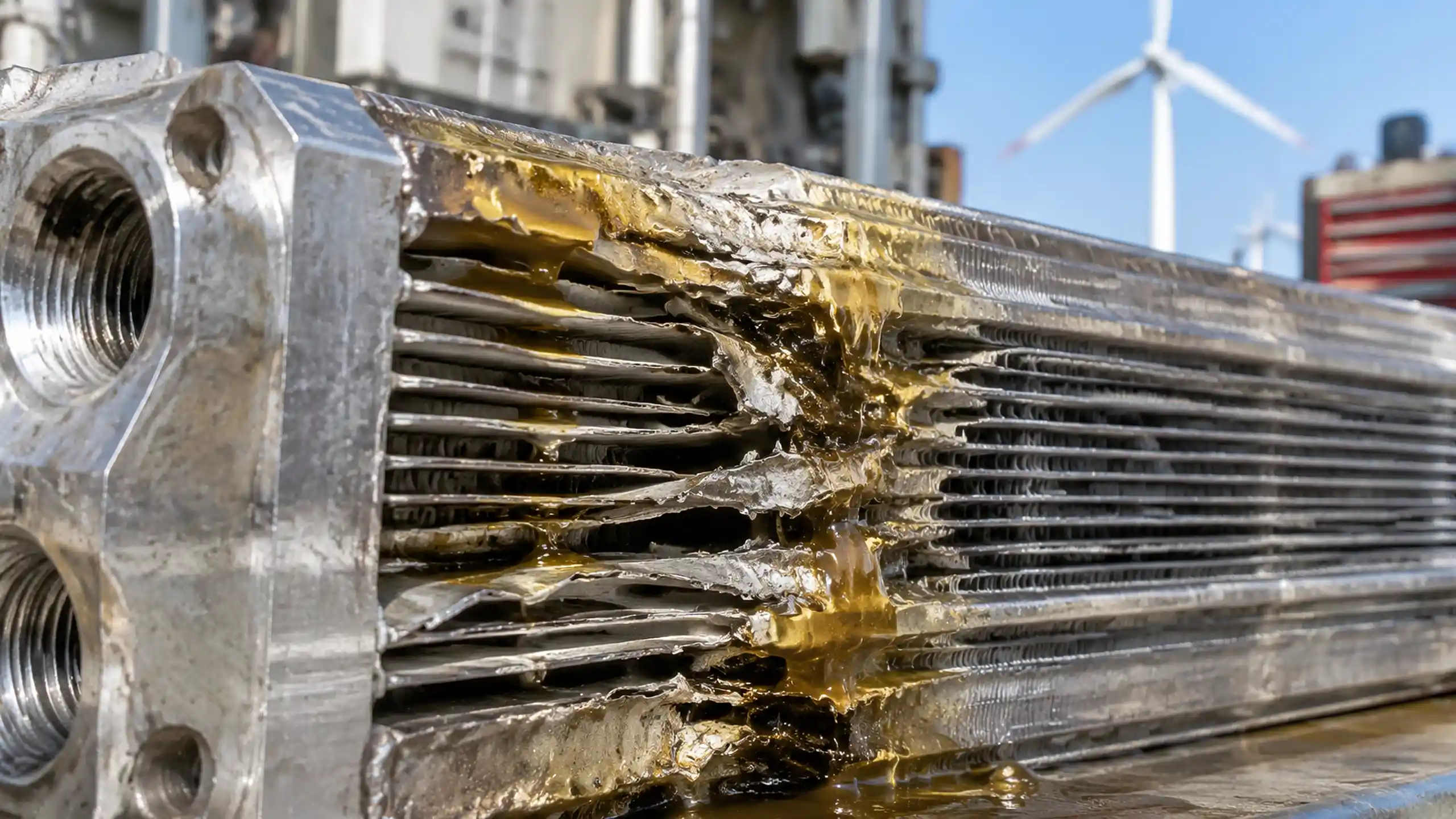
Review the pressure envelope from the actual drawing
Ask for the following values from the cooler design:
- Maximum continuous working pressure
- Maximum transient pressure and duration
- Proof pressure
- Burst pressure
- Pressure-cycle test conditions
- Minimum design temperature
- Braze and material qualification
- Port and mounting-load limits
A room-temperature burst test does not automatically qualify a cooler for a cold-start pressure spike. The test plan should reflect the minimum site temperature, the actual pressure profile and the number of expected starts over the service life. For related manufacturing questions, see the vacuum brazing versus CAB comparison and the bar-and-plate oil cooler assembly.
What to inspect after a suspected cold-start burst
- Photograph and record the leak or rupture location before cleaning the part.
- Check whether the bypass valve is stuck closed, slow to open or incorrectly assembled.
- Verify the relief valve set pressure and confirm it is not blocked or undersized.
- Collect the oil datasheet and compare the reported viscosity with the start temperature.
- Review the pump start sequence, heater operation and pressure-sensor log.
- Inspect the core for deformation, cracked braze fillets and damaged port connections.
- Pressure-test the assembly and review the failed joint with the supplier.
Do not replace the cooler until the pressure source has been identified. A new core installed into the same failed protection system can repeat the failure on the next cold start.
How to reduce cold-start burst risk
- Use an oil with a verified low-temperature viscosity and pour point for the site.
- Maintain the thermal bypass and pressure relief system.
- Verify relief-valve capacity, not only its set pressure.
- Use a controlled start-up procedure and confirm the pump unloading sequence.
- Provide oil heating or trace heating where the site requires it.
- Log pressure at the cooler inlet and outlet during cold starts.
- Select a core with documented proof, burst and fatigue ratings for the actual pressure profile.
- Check for contamination or a restricted filter that adds pressure drop.
- Do not solve a protection problem by fitting a larger cooler alone.
For a custom cooler review, send the gearbox model, oil data, start temperature, pump curve, valve settings and measured pressure transient to our engineering team. The industrial machinery cooling page also covers related gearbox and plant cooling applications.
Cold-start failure checklist for the service team
| Check | Evidence to collect | Why it matters |
|---|---|---|
| Oil grade and low-temperature data | Product datasheet, viscosity at minimum start temperature and pour point | ISO VG alone does not define cold-start behavior |
| Bypass function | Opening temperature, travel, spring and seal condition | A closed or slow bypass sends cold oil through the core |
| Relief protection | Set pressure, capacity, pilot line and response | The pump may otherwise overpressure the cooler |
| Start sequence | Pump speed, unloading, heater and control logic | Fast starts increase the pressure transient |
| Pressure log | Inlet, outlet and differential pressure over the first minutes | A single gauge reading can miss the peak |
| Core qualification | Proof, burst, fatigue and minimum-temperature test data | A nominal pressure rating may not match the transient |
| Contamination | Filter, oil analysis and passage restriction | Dirt or varnish adds pressure drop during cold starts |
What to send for a replacement review
Send the following to avoid an oversized or technically mismatched replacement:
- Gearbox make and model
- Cooler part number and drawing
- Oil manufacturer and grade
- Minimum ambient and oil temperature
- Low-temperature viscosity and pour point
- Pump flow and pressure curve
- Bypass and relief valve settings
- Measured cold-start pressure trace
- Pressure and temperature rating required
- Connection and mounting dimensions
- Site conditions and maintenance history
If the problem is ordinary overheating rather than a cold-start burst, review the bar-and-plate oil cooler sizing method. If the cooler is mechanically sound but the oil is overheating at normal ambient, verify flow, air blockage and heat load before replacing the core.
Need help investigating a cold-start cooler failure?
Send the gearbox and cooler details, the oil datasheet, the cold-start pressure record and photos of the failed joint. Our engineers can review the pressure-protection sequence and help determine whether the correct action is a valve repair, an oil or warm-up change, or a pressure-qualified replacement cooler.
Frequently Asked Questions
Why do wind turbine gearbox oil coolers burst during low-temperature cold starts?
Cold oil has a much higher viscosity, which can produce a high pressure drop through the cooler. If the bypass or relief protection does not open correctly or the pump pressure exceeds the core rating, a transient pressure surge can deform or rupture a braze joint.
Does ISO VG 320 define the viscosity at -20°C?
No. ISO VG 320 defines a viscosity grade at 40°C. The low-temperature viscosity depends on the base oil, viscosity index, pour point and additive package. Always use the actual oil datasheet for the start-up temperature.
Is 40 bar a universal burst pressure for bar and plate oil coolers?
No. A 40 bar pressure surge may exceed the design margin of a particular circuit, but the failure pressure depends on the core design, materials, braze quality and qualification test. Confirm the actual pressure envelope for the supplied cooler.
Can a failed bypass valve cause a cooler to burst?
Yes. If the bypass remains closed or responds too slowly, cold oil is forced through the restricted core. The resulting pressure can rise until the relief valve opens or a weak joint deforms. A blocked or incorrectly set relief valve makes the risk worse.
What information is needed to review a replacement cooler?
Provide the gearbox model, cooler part number, oil datasheet, minimum start temperature, pump flow and pressure curve, bypass and relief settings, measured cold-start pressure, connection details and available installation envelope.