
2026-09-07
Why do vacuum brazed cold plates leak internally?
Internal leakage in vacuum brazed cold plates usually comes from three flaws: incomplete brazing fill, coolant corrosion and thermal fatigue. Here is how to spot and prevent each one.
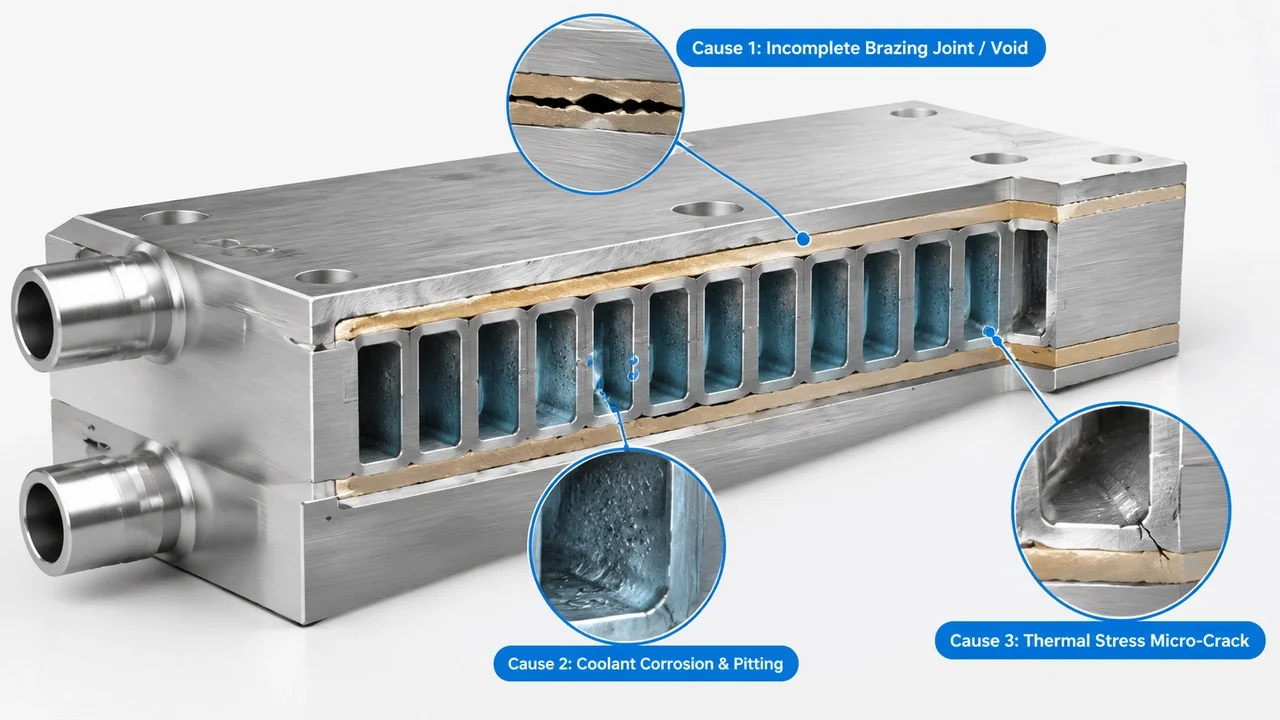
Figure 1: Cross-section of a vacuum-brazed cold plate showing braze-void, corrosion and thermal-fatigue failure points.
A vacuum-brazed cold plate is a sealed aluminum heat exchanger that carries coolant through internal channels to pull heat away from power electronics, IGBT modules, batteries or laser systems. Because the plate is brazed as one piece, there are no gaskets or mechanical seals - which is exactly why an internal leak is so hard to find: coolant can migrate between internal channels without ever dripping outside the unit.
For a thermal engineer or procurement manager, an internal leak usually shows up as rising thermal resistance, a conductivity failure or a sudden pressure drop - not a visible puddle. Understanding the three root causes below is the first step to preventing field failures.
Internal leakage in vacuum brazed liquid cold plates typically stems from three manufacturing or operational flaws:
- Incomplete Brazing Joint Fill: Poor alloy distribution during the vacuum brazing process leaves voids in the joint.
- Corrosion & Erosion: Using non-compatible coolants (for example, untreated water with copper/aluminum contact) causes galvanic corrosion.
- Thermal Fatigue: Repeated rapid temperature cycling causes stress cracking at the joints.
To prevent this, ensure your supplier performs 100% helium leak testing and uses ASME-grade raw materials.
The Three Root Causes in Detail
1. Incomplete Brazing Joint Fill
Vacuum brazing joins the plate and cover layers by melting a thin aluminum-silicon alloy that flows into every joint by capillary action. If the alloy is poorly distributed, the furnace profile is wrong, or the surface is contaminated, the molten alloy never fills the joint completely. The result is a hidden void: the plate passes a room-temperature pressure test, then opens up under thermal cycling or system pressure. This is the most common cause and the one that is almost invisible until the cold plate is in service.
2. Corrosion & Erosion
Aluminum cold plates are designed for a specific coolant chemistry. When an incompatible fluid is used - untreated water, or a coolant that creates a copper/aluminum galvanic couple in the loop - corrosion starts at the internal channel walls and braze joints. Over months, the corrosion erodes the thin wall between channels and can bridge two fluid circuits. Coolant flow rate, filtration and inhibitor levels all affect how fast this damage develops.
3. Thermal Fatigue
Every power cycle expands and contracts the aluminum core. A cold plate that heats and cools rapidly, thousands of times, puts repeated stress on the braze joints at the channel boundaries. If the joint has any micro-porosity or the design concentrates stress, a micro-crack forms and slowly grows until it links two channels. Thermal fatigue failures are typical in high-power-density applications with aggressive duty cycles.
How to Prevent Internal Leakage
- Insist on 100% helium mass-spectrometer leak testing on every plate before shipment - helium finds the micro-leaks that pressure testing misses.
- Specify certified ASME-grade aluminum alloys and full material traceability for the plate and braze alloy.
- Validate the braze process with cross-section samples and process audits at your vacuum brazing supplier.
- Use the coolant the cold plate was qualified for, with correct inhibitors, filtration and flow.
- Run thermal-cycle validation on prototypes for your real duty cycle before production.
FAQ
Why do vacuum brazed liquid cold plates leak internally?
Internal leakage typically stems from three causes: 1) Incomplete brazing joint fill due to poor alloy distribution, 2) Corrosion and erosion from incompatible coolants causing galvanic reactions, and 3) Thermal fatigue cracking under rapid temperature cycles.
How do you prevent internal leakage in vacuum brazed cold plates?
Ensure your supplier performs 100% helium mass spectrometer leak testing and utilizes certified ASME-grade raw materials.
Specifying or troubleshooting vacuum-brazed cold plates? Send us your drawings, coolant and duty cycle - our engineers will review the design and recommend custom vacuum-brazed coolers or OEM/ODM options within 24 hours.
Need Help Selecting an Oil Cooler?
Send us your specs or drawings and our engineers will size the right cooler for you within 24 hours.
Get a Free Quote Chat on WhatsApp