
2026-09-15
How to Prevent Heavy-Duty Radiator Clogging in Open-Pit Mining?
Heavy-duty radiator clogging in open-pit mining blocks airflow and drives engine overheating. Learn how non-louvered 6-8 FPI fins and reversible fans keep the core clear in severe dust.
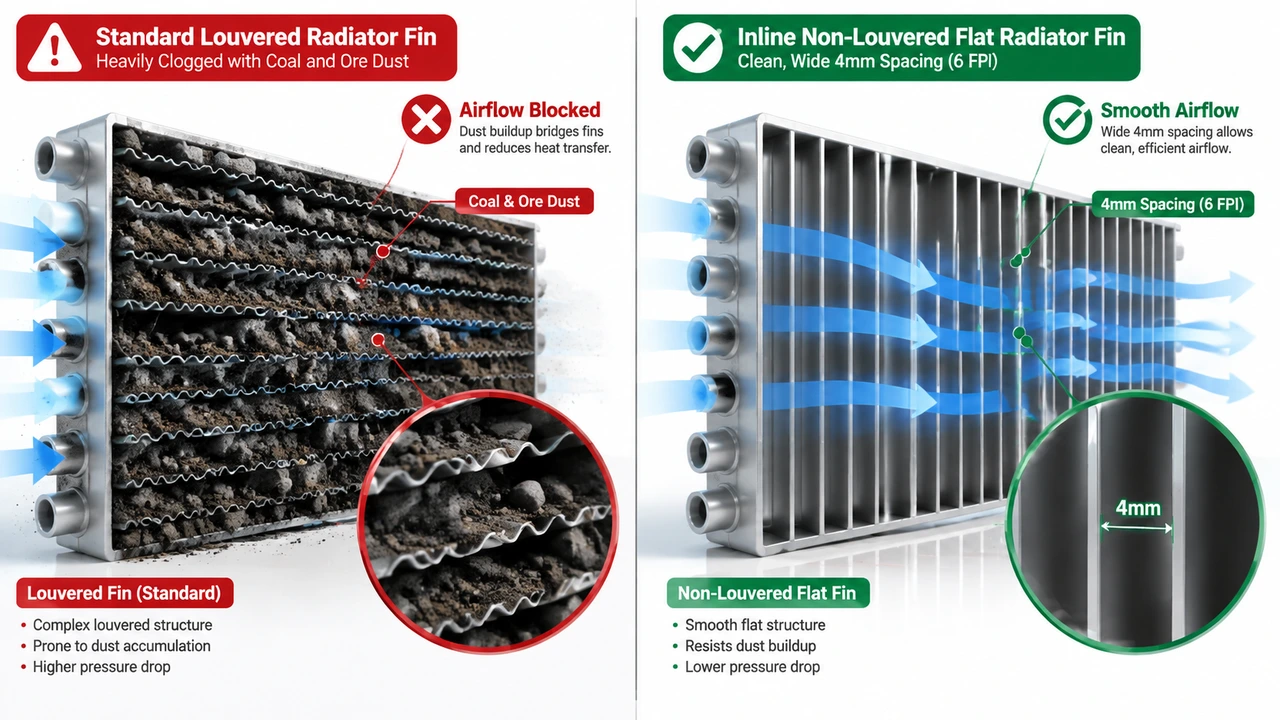
Figure 1: Louvered Fin (Clogged) vs. Inline Non-Louvered Flat Fin (4mm / 6 FPI Smooth Airflow) in Mining Applications.
Quick Answer: To prevent heavy-duty radiator clogging in open-pit mining, replace standard louvered fins with inline non-louvered flat fins, open fin spacing to 3.0-4.5 mm (6-8 FPI), and use automatic reversible cooling fans to purge loose debris. Keep intake guards open enough for airflow, and inspect the core every shift in high-dust conditions.
Heavy-duty radiator clogging in open-pit mining is not caused by one dirty filter or one missed wash. Excavators, haul trucks and wheel loaders continuously pull coal dust, silica and ore fines through the cooling package. When the radiator core traps that dust, airflow falls, coolant temperature rises and the machine may be derated or stopped. A radiator designed for clean highway air often reaches that point much faster than one engineered for a mining duty cycle.
The most effective solution is to prevent dust from bridging between the fins in the first place. For high-dust applications such as open-pit mines, quarries and tunnels, this means changing the fin geometry, opening the fin pitch and adding an automatic cleaning cycle. It also requires the intake guard, fan control and service access to work together as one cooling system.
Why Do Radiators Clog So Quickly in Open-Pit Mining?
A standard radiator uses a dense core to create a large heat-transfer surface in a compact package. Many designs also use louvered fins. The small louver openings improve heat transfer in clean air, but in a mine they can behave like a sieve. Coal, sand, silica and mineral dust collect inside the louvers, then moisture or oil mist can cement the particles into hard bridges across the airflow passages.
Once dust bridging begins, the process accelerates:
- Airflow falls while the fan continues to consume power.
- Coolant and oil temperatures rise under load.
- Hot spots increase thermal stress in the core and tank joints.
- The operator compensates with lower load, longer pauses or more frequent shutdowns.
- High-pressure washing may bend fins or drive dirt deeper into the core.
For equipment used in construction machinery cooling, the objective is not to eliminate every particle. It is to let particles pass through the core more easily and remove what does settle before it becomes a hard blockage.
Quick Answer: What Stops Mining Radiator Dust Clogging?
Three engineering changes deliver the greatest benefit:
- Use inline non-louvered flat fins so dust has a straight path through the core instead of being captured by louver openings.
- Increase fin pitch to 3.0-4.5 mm, approximately 6-8 FPI, to prevent dust from bridging across narrow passages.
- Install automatic reversible fans so airflow periodically reverses and purges loose debris from the intake face.
The design should be matched to the machine's heat load, fan curve, dust type and cleaning access. A wide fin pitch that is not supported by enough core volume can reduce heat rejection, so the radiator must be sized as a complete thermal system.
3 Proven Engineering Solutions to Eliminate Radiator Clogging
1. Switch to Inline Non-Louvered Flat Fins
Standard automotive and light-industrial radiators often use louvered fins to create turbulence and improve heat transfer in clean conditions. In a mining pit, those tiny louvers become physical traps for abrasive dust.
Non-louvered flat fins provide a smoother, more continuous airflow path. Coal and ore particles can travel through the core instead of settling in the fin openings. The result is slower pressure-drop growth and more stable cooling performance between maintenance intervals.
Non-louvered construction does not mean weakening the core. The fin, tube and header design still needs to resist vibration, thermal cycling and internal pressure. For severe-duty equipment, the core should be pressure-tested and the complete assembly checked for mounting and connection loads.
2. Optimize Fin Spacing to 4 mm (Approximately 6 FPI)
A standard radiator may use 12-16 FPI. That density is suitable when the incoming air is relatively clean, but it is too tight for heavy airborne dust. For open-pit mining, fin spacing is commonly opened to 3.0-4.5 mm, or approximately 6-8 FPI.
The wider gap reduces the chance of dust bridging, where particles collect across a narrow channel and form a stable blockage. A 4 mm pitch is equivalent to about 6 FPI and is a practical design target when the thermal calculation supports it.
Wider spacing must be balanced against available core volume. If space is limited, the supplier may adjust core depth, tube count, fin height or airflow rather than simply reducing fin density. This is why a custom thermal review is more reliable than copying a generic radiator drawing.
3. Install Automatic Reversible Cooling Fans
A programmable reversible fan changes airflow direction on a set cycle. During the reverse cycle, air is pushed outward through the radiator and intake guard, carrying loose dust away from the core. A common starting point is a short purge every 20-30 minutes, but the interval should be tuned to dust severity, fan design and machine duty.
Reversible fans are most effective when the core has open fin spacing and the guard does not trap the released debris. They reduce manual cleaning frequency, but they do not replace inspection. Wet mud, oil-contaminated dust and mineral scale can still adhere to the core and require a controlled wash.
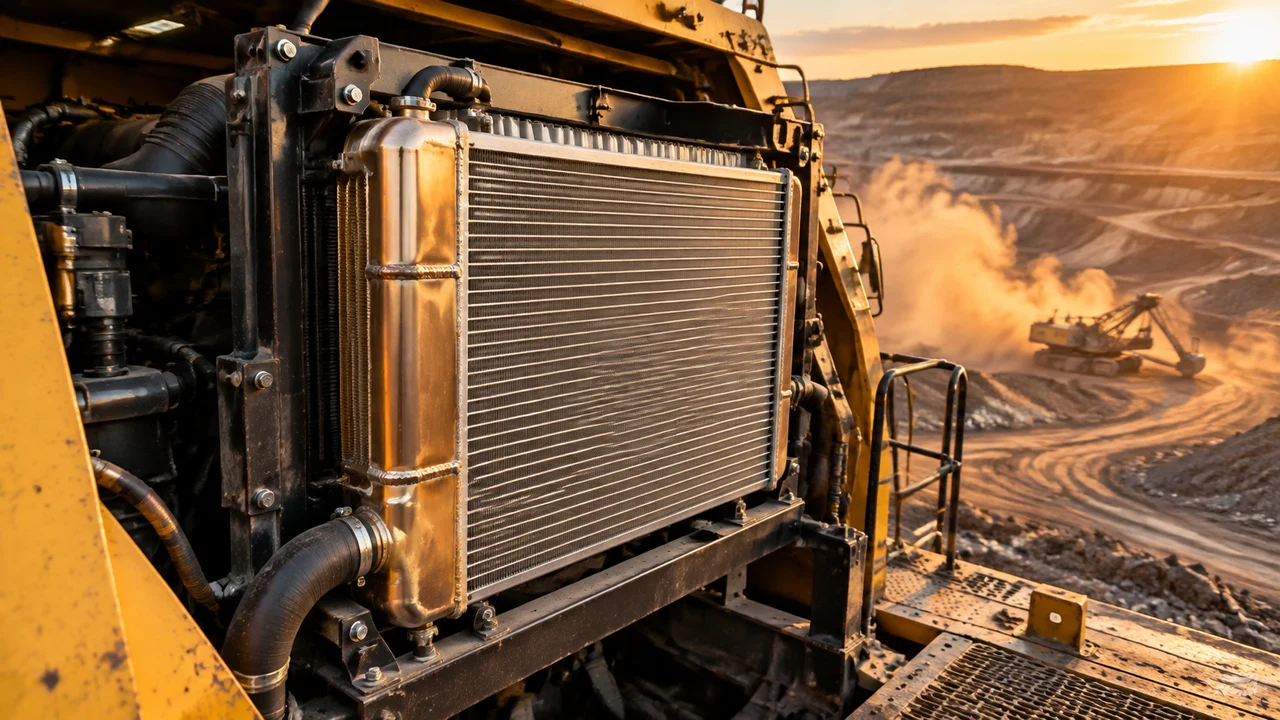
Louvered vs. Non-Louvered Mining Radiator Fins
| Design Parameter | Standard Louvered Core | Mining Heavy-Duty Flat Core |
|---|---|---|
| Fin type | Louvered, sieve-like structure | Inline non-louvered flat fin |
| Fin density | 12-16 FPI, narrow spacing | 6-8 FPI, 3.0-4.5 mm pitch |
| Dust bridging tendency | High in coal, silica and ore dust | Low; particles follow a straighter path |
| Airflow pressure drop | Rises rapidly as dust cakes | More stable between inspections |
| Cleaning demand | Frequent, often reactive | Condition-based, supported by fan purge |
| Typical operating environment | Clean on-road or light industrial air | Open-pit mine, quarry, tunnel, severe dust |
The comparison is not a claim that a flat-fin core never needs cleaning. It shows why fin geometry matters in a high-dust environment and why a standard louvered core can become the bottleneck in an otherwise well-maintained cooling system.
Recommended Anti-Clogging Radiator Specifications
| Specification | Recommended Direction | Why It Matters |
|---|---|---|
| Fin type | Inline non-louvered flat fin | Reduces dust capture and bridging |
| Fin density | 6-8 FPI | Opens the air path while retaining heat-transfer area |
| Fin pitch | 3.0-4.5 mm | Prevents narrow-gap dust arches |
| Core material | Vacuum-brazed aluminum, selected for the duty cycle | Provides a strong, leak-resistant heat-exchange core |
| Tank and header | Welded steel or reinforced aluminum to suit pressure and mounting | Resists vibration and thermal cycling |
| Fan control | Automatic reversible cycle with adjustable timing | Purges loose debris without stopping the machine |
| Intake guard | High open-area, removable or hinged design | Protects the core without becoming a dust trap |
| Mounting | Correct vibration isolators and non-preloaded brackets | Prevents movement from damaging the radiator |
| Service access | Clear wash path and drainage | Makes scheduled cleaning practical |
| Pressure protection | Correct cap rating and relief system | Limits stress during thermal expansion |
The final specification must be confirmed against the machine's heat rejection, coolant flow, fan performance, altitude and maximum ambient temperature. A mining radiator is a custom thermal component, not a catalog size selected by dimensions alone.
Installation and Maintenance Checklist
- Every shift: Inspect the intake guard and core face for trash, mud or the first signs of dust bridging.
- During operation: Record coolant temperature, fan behavior and any increase in cleaning frequency.
- At the recommended purge interval: Verify that the reversible fan actually reverses and that the guard releases the debris.
- At scheduled service: Check mounts, hoses, brackets, cap operation and vibration isolators.
- During cleaning: Follow the OEM procedure and use low-pressure air or water from the normal airflow outlet side. Avoid holding a high-pressure nozzle close to the fins.
- After cleaning: Confirm the core is dry, unrestricted and free from bent or crushed fins before returning the machine to service.
Keeping a simple temperature and cleaning log is valuable. A rising temperature trend at the same load can reveal a partially blocked core long before an alarm or shutdown occurs.
Selection Checklist for Mining Excavators and Haul Trucks
Provide these details when specifying an anti-clogging radiator:
- Machine make, model and operating weight
- Engine or hydraulic heat rejection and coolant flow
- Fan diameter, blade type, speed and available power
- Inlet and outlet positions, connection sizes and pressure rating
- Radiator envelope, mounting points and vibration isolation
- Dust composition, moisture exposure and cleaning method
- Ambient temperature, altitude and maximum sustained load
- Guard clearance, access space and reversible-fan controls
These inputs allow the radiator core, fin pitch, tank design and fan cycle to be reviewed together. For a comparable custom heat exchanger, see our custom OEM oil cooler and radiator assemblies.
When a Custom Heavy-Duty Radiator Is the Better Choice
A custom solution is usually justified when the original radiator overheats repeatedly, the machine works in more severe dust than the standard design allows, or replacement parts have long lead times. It is also useful when the machine has been modified with a larger engine, different hydraulic package or additional duty cycle.
TH reviews the installation and cooling requirement before selecting fin geometry. The design can use an inline non-louvered flat core, reinforced headers, a suitable guard and a reversible-fan strategy. For related equipment, review our heavy-duty excavator cooler solutions and OEM/ODM manufacturing service.
FAQ
Why do standard radiators clog easily in open-pit mining?
Standard radiators often use louvered fins and 12-16 FPI density. Airborne coal, sand, silica and ore dust become trapped in the louvers and narrow passages, forming dust bridges that restrict airflow and raise coolant temperature.
What fin design is best for mining radiators?
Inline non-louvered flat fins with 3.0-4.5 mm pitch, usually 6-8 FPI, are preferred for high-dust mining duty. They provide a straighter path through the core so fine particles are less likely to lodge between the fins.
Can reversible fans replace manual radiator cleaning?
No. Reversible fans reduce cleaning frequency by purging loose debris, but the radiator still needs scheduled inspection and cleaning. Caked mud, oil-soaked dust or mineral scale may require manual washing.
How often should a mining radiator be inspected?
Inspect the core at the start of every shift in severe dust and record the coolant temperature and airflow condition. Clean when visible dust bridging begins, not only after the machine overheats.
What information should be supplied for a custom anti-clogging radiator?
Provide the machine make and model, drawings, mounting points, inlet and outlet positions, heat rejection, coolant flow, fan diameter and speed, ambient dust conditions, altitude and maximum working pressure. Photos of the installation help confirm guard and service clearance.
Need a Custom Anti-Clogging Radiator for Your Mining Fleet?
We engineer and manufacture high-durability cooling assemblies for severe dust and vibration, including machines from Caterpillar, Komatsu, Hitachi and Liebherr. Send the machine model, duty cycle, dust conditions, mounting drawing and heat-load data. Our engineers will review a custom non-louvered 6-8 FPI design and reply with the next technical questions or sizing recommendation.
Request a custom thermal design quote and include photos of the current radiator installation so the guard clearance and service access can be checked as well.
Need Help Selecting an Oil Cooler?
Send us your specs or drawings and our engineers will size the right cooler for you within 24 hours.
Get a Free Quote Chat on WhatsApp